Academy Street, Belfast – Teenage Rebellion, Oddfellows Hall and the Blitz!

Academy Street

In the late 18th century, Arthur Chichester, 5th Marquess of Donegall and landlord of Belfast was keen to extend and improve ‘his’ town. He leased land to the architect-builder Roger Mulholland, with the proviso that new streets and buildings would be constructed. Academy Street was part of this plan. The street derived its name as it was the site of one of Belfast’s earliest schools, the Belfast Academy, which opened in 1796.

Roger Mulholland
Roger Mulholland was born in 1740 in County Derry. Roger trained as a carpenter before attending the Dublin Society’s School of Drawing in Architecture. He enrolled as a mature student on 2nd February 1769.
On 1st January 1770 he married Jane Russell of Belfast. The Mulholland’s rented a timber yard in Rosemary Street in 1783. In 1789 he also had bigger premises on the south-side of Ann Street, though he sold these in 1792 to Belfast merchant Narcissus Batt for £113.
“These docks were generally filled with logs of timber, and the timber merchants in Ann Street and Poultry Square had slips into them for landing it”
Thomas Gaffikin, Belfast Fifty Years Ago, 1875

Design and Construction
Mulholland moved on to bigger projects in design and construction. He was responsible for the building of the House of Correction on the corner Howard Street and Fisherwick Place (facing today’s Grand Opera House). He also rebuilt the First Presbyterian Church on Rosemary Street. The old church was demolished and the bricks reused. The construction cost was £1,207 10s 6d (exclusive of the lead for the roof).

By at least the 1780’s the Mulholland’s were a successful and prosperous family. Roger and Jane had 2 sons George and Waddell (there were possibly 2 more), and 2 daughters, Margaret and Mary.
In 1782 Roger donated £100 towards the building of the new White Linen Hall, completed in 1785, on the site of today’s City Hall. Mulholland was also one on the founding members of the Society for Promoting Knowledge (see post Linen Hall Library – A History of Education, Philanthropy and Rebellion). He was president of that society in 1791-92. He presented the library with a 3-volume set of ‘Vitruvius Britannicus’ as well as a copy of ‘Caesar’s Commentaries’.
The Volunteers
In the 1770’s, like many other of Belfast’s first citizens Mulholland joined the Volunteers. This was a voluntary Protestant militia set up to defend Ireland from foreign invasion whilst English troops were engaged in America in the War of Independence.
Roger enlisted in the Belfast First Volunteer Company under the captainship of leading businessman Waddell Cunningham. Although never a regular attender, Mulholland did call one of his sons after Cunningham.
In 1783 Mulholland leased land off Lord Donegall in Buller’s Field and the area surrounding the new St Anne’s parish church (which replaced the Corporation Church on High Street). Here he was responsible for the building of various street such as Academy Street, Talbot Street, Donegall Street, Hill Street, William Street and Dunbar Street. This involved the construction of hundreds of houses and business premises.
In 1787 Roger rebuilt the former coach house at the site of Belfast castle (see post Old Belfast Castles – What Lies beneath our Streets?). This building was used as the offices of Lord Donegall’s Belfast agent and became known as ‘The Castle’. He also built three grand houses on Donegall Place which he rented to Dr McDonnell, the Rev Edward Patterson and a Mr John Smith for an annual rent of £34 2s 6d.

Mulholland also rented 8 acres of land off Donegall in the Cromac Wood area. He is thought to have built the original houses on what is now the Ormeau Road. The Mulholland’s lived at Cromac Lodge from 1786 till 1799.
Roger Mulholland died on 30th November 1818 at his home 12 Castle Street, aged 78. He left a substantial estate of £3,835 17s and two and a half pence.
“He was certainly the most important architect and speculative builder of the northern counties of Ireland in the second half of the 18th century….and the first native architect to practice on any considerable scale in Belfast”
C E B Brett, Roger Mulholland Architect of Belfast, 1976
Early Academy Street
Originally Academy Street ran in a ‘dog-leg’ from Donegall Street to Great Patrick Street.
Before settling on the name Academy Street, it had also been known as Long Lane, Academy Row, Linen Hall Street and William Street.

Construction of Belfast Academy
In 1786, Scotsman the Rev James Crombie secured a 99-year lease from Lord Donegall to establish a school. Crombie was the minister of the First Presbyterian Church on Rosemary Street.
Belfast Academy (it was to become Belfast Royal Academy in 1888) was situated at No 2 on the corner of Academy Street and Donegall Street, close to where St Anne’s cathedral stands today. It was described as “an airy, healthful situation”. At this time there was no York Street so the school had views towards the Poor House and Carrick Hill.
According to the historian D J Owen the original project was to be a Presbyterian seminary, funded in part by a donation of £1,300 from a Mr Arthur Maxwell. However, this plan seemed to hit legal difficulties.
“Although much of this money was lost by litigation other sums were raised, and eventually the “Belfast Academy” was built and opened in 1786, with Dr Crombie as its first principal”
D J Owen, History of Belfast, 1921

Description of the Academy
The building consisted of 3-storeys. Schoolrooms were on the ground level with dormitories on the higher floors. A cow byre with an upper hay loft was at one end.
The school buildings extended along Academy Street and the principal’s house was on the corner fronting Donegall Street.
Courses Offered
Instruction was given in Classical Studies, English, Writing and Mathematics. A Monsieur J. Jorre from Rouen was appointed as a French tutor. He received a salary of one guinea a quarter from each student he taught.

The Academy arranged evening adult courses. There were also classes for young ladies in the afternoons for English, French, Italian, drawing and dancing (All the social niceties for girls). Of course, these would only be attended by the well-off who could afford the tuition fees.
Living in the Academy
The dormitory consisted of 28 beds with straw mattresses and blankets. The day of the boarder began at 7 o’clock in the morning with prayers in the Common Room and ended with evening prayers at 8’ clock.
Food and furnishings were plain and functional. The school was run on a very strict basis as was the norm at the time, the exception being the David Manson school (see post David Manson – Belfast’s Enlightened Schoolmaster).
One ex-pupil described it thus
“The cane was in those days an established institution. None of the departments I have named were without it, and in some of them it was in daily, almost hourly requisition. Looking back to those distant times, I now see that the system of education was not good. Punishment was the ruling principle…..”
As told to George Benn A History of the Town of Belfast Vol 2 1880
Teenage Rebellion

Instigation of the Protest
The school board issued numerous regulations –
- boys were to study hard, arrive at class with their faces washed and hair combed.
- No swearing or fighting
- No dogs or guns in school without the principal’s permission.
It was this last rule that was spectacularly flouted in 1792.
Student Revolt
In the early hours of Thursday 12th April 1782, 9 boys (7 boarders and 2 day-boys) barricaded themselves in the Mathematical Room. They had supplies of 5 pistols, ammunition, roast beef and loaves of bread. Their grievance was that the new principal, the Rev William Bruce, had shortened the school holidays and abolished the Easter break altogether.
The Rev Bruce and his wife Susanna (nee Hutton), who was in charge of the dormitories, informed the pupils that if they opened the door within 15 minutes no more would be said. The teenagers refused and even fired a shot close to Mrs Bruce.
A locksmith was sent for but he too was fired upon, as was a mason who was deployed to empty water down the chimney. The President John Holmes and the Sovereign William Bristow were summoned, but their entreaties met ‘deaf ears’. (Interestingly, two of the boys were related to Bristow).
“The sovereign arrived in person and informed his relatives in writing that the firing of a loaded pistol at any person was a capital felony. The defiant reply was that they would lodge a ball in the sovereign’s wig”
A T. Q. Stewart. Belfast Royal Academy The First Century, 1985
The teenagers, writing from what they called ‘Liberty Hall’, produced their demands. Basically, the right to have their traditional holidays, an extended curfew to 9pm at weekends if they were visiting a ‘Gentleman’s house’ and a guarantee that they would not be punished or expelled for their actions.
“As our conditions are not difficult to be granted we hope that you Gentlemen, professors of liberty, will incline a favourable ear to our request. If, Gentlemen, you grant our request and Dr Bruce will pledge his honour to see the articles herein required performed we will immediately surrender”
Eventually, after much negotiation the boys relinquished their weapons. The following day Bruce drew up a document in which the insurgents repented of their actions. However, the youngsters refused to sign. The result was that each boy received ‘twelve stripes’ in front of the assembled Patrons.
Consequences of the Protest
The whole incident had a negative effect on Bruce’s reputation, although such ‘barring-out’ episodes were apparently not uncommon, especially in England and Scotland.
“The episode was a trying and painful one for Bruce, and he was sensitive to the use which his critics might make of it. He was no believer in sparing the rod, and there were murmurings in the town that his harshness had provoked the rebellion”
A. T. Q. Stewart Belfast Royal Academy The First Century, 1985
Dr Bruce offered to resign, but this was not accepted and he continued as school principal for a further 30 years. The boys who had rebelled and those responsible for smuggling in the ammunition – C. Auchinleck, I. Stouppe, F. McMinn, C. and P. Riall, A. Atkinson, J. Verner, J. Arbuckle, J. Crombie (son of the former principal) J. Lowry and W. Cunningham – all left soon after.
We are told that in future years the arithmetical teacher, Mr D_, kept a supply of corks in his room which he inserted in the bullet holes in the door to silence the noise from outside.
By the mid- 19th century Belfast Academy was described as “a dingy edifice” by Narcissus Batt. In 1880 the school moved to its current position on the Cliftonville Road, in north Belfast.
Artist Joseph Molloy
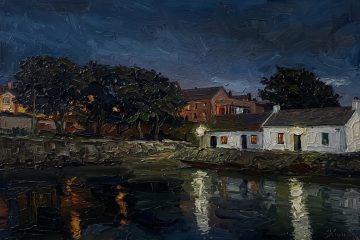
For a short time, the artist Joseph Molloy taught in Belfast Academy. Born in 1798 Molloy sketched and painted many local scenes including 30 views of Belfast Scenery, Gracehill, County Antrim and Whitehouse Village by Belfast Lough.
He was employed as an art teacher in the school in 1828 and subsequently in the Belfast Academical Institution.
He was also a member of the Association of Artists founded in Belfast in 1836. Its first exhibition was held in the Museum on College Square North.
Among his works are Portrait of a Young Man, Jennymount, Tilbury Fort and Folkestone, Kent.
Joseph died on 9th December 1877, at his home Hazelfield Cottage, Crumlin Road. He is buried in Friar’s Bush Cemetery (see post Friar’s Bush Graveyard – A Fascinating History).
Other Academy Street Businesses/ Residents
Another less prestigious school situated on Academy Street was St Anne’s Parochial School at No 27. In 1852 Mr Robinson was the master and Mrs Morrow the mistress.
A Mrs Kennedy also ran a Dancing Academy on the street.
In addition, Academy Street was home to various religious and medical bodies. In 1840 a Baptist Church was at No 44 and in 1850 a Methodist Meeting House was at No 40. No.s 54-58 housed the Salvation Army Quarters and Hall. From 1870 there was the Academy Street Presbyterian Church.
In the 1850’s Dr Robert Bryce had his surgery at No 7 Academy Street, while in 1861 E. J. Carew was a licentiate apothecary at No 17.

In 1865 Dr Henry Purdon founded a Dispensary for Skin Diseases here. Purdon came from a long line of medical doctors. He was also the physician for the Belfast Poor House. This facility was replaced in 1875 when a new larger facility was opened on Glenravel Street thanks to the philanthropy of Edward Benn (see post Edward Benn – Three Belfast Hospitals).
The architect William Hastings also had his residence on the street.

McClintock & Thompson, Soap and Candle Manufacturers
Many other businesses found the city centre location of Academy Street ideal. One such was the firm of McClintock & Thompson, Soap and Candle Manufacturers, established in the 1840’s. They had a three-storey building at No 55. The ground floor was used as a salesroom and offices, the candle making was on the upper floors and the soap-boiling and melting works were at the rear of the building. They were particularly famous for ‘Barilla Soap’ made from the ash of the barilla plant.
“There is something in the composition of this barilla ash which makes it astonishingly curative and most agreeable on the skin… This is no small triumph for a Belfast firm, to have gained such a position in the manufacture of an article to which the age has devoted so much money and scientific skill and is another illustration that by some happy fortune, the manufacturers of the city seem to get to the top of the tree in every industry to which they devote themselves”
Industries of the North 1888-91
Kitty Walker’s Bakery
Academy street was also the location for a number of smaller businesses over the years. At No.1 was Kitty Walker’s bakery, famous for her apple tarts.
“Every Academy boy of that time had happy memories of Kitty Walker’s cake shop at the corner of Academy Street and her celebrated apple tarts, several of which could be consumed without gastronomic disaster”
A. T. Q. Stewart, Belfast Royal Academy The First Century, 1985
Other Residents
In 1852 John McKenna ran a grocery and spirit merchants’ business from numbers 39-41. Across the street at No. 48 was Thomas Shields pawn broker.
Other residents of the street included
No 14 Samuel McMillen, tow merchant
No 15 S. McCabe, carver and gilder
No 23 Bridget Morris, clothes dealer
No 31 Benjamin Alcorn, loom and general carpenter
In 1887 both Margaret McSwiggan and C. B. Finch had Refreshment Houses on Academy Street. In the 1890’s John Stott, Hugh Ferris, W. Convey, F. O’Hagan and H. McAlinden were publicans.

The Current Education Authority Building
The most notable building still existing on Academy Street is that currently housing the Education Authority. It was constructed in 1899-91 as a warehouse for Kirker, Greer & Co., who were distillers and blenders.
The building was designed by Samuel Stevenson, who was also responsible for the Grand Central Hotel (1892) – (see post From Hercules Lane to Royal Avenue, Belfast), Gallaher’s Tobacco Factory (1896) on nearby York Street and the College of Technology (1907). This is an imposing 3-storey building composed of red brick with pavilion roofed towers. The castellated turrets were adorned with lanterns on Westmorland slates. Over the entrance was a projecting bay window. The gable within the recessed archway bears the date 1901.
Kirker & Greer originated from a soda water manufacturing business run by a Mrs Warnock at No. 24 Academy Street. By 1870 it was named Kirker & Co. Around a decade later they were distillers and wine and spirit merchants and had extended to Nos 30-34, before having their own premises constructed.

Academy Street , Belfast Street Directories
In 1822 there were 49 houses in Academy Street. These were the homes of 128 men and 161 women.
By the turn of the 20th century there were nearly 200 people living on Academy Street. These were mainly ‘blue collar’ workers, many employed in the mills or the nearby docks.
Just a few of the residents:
- No 29 John Roseberry (45) – harbour navvy
- No 61 William Skey (56) – stevedore
- No 67 Matthew Smyth (30) – dock labourer
- No 87 Joseph McCarthy (16) – apprentice flax dresser
- No 17 Daniel McCusker (31) – flax rougher
- No 33 Isabella Carmichael (35) – linen smoother
Accommodation on Academy Street
A number of houses on the street also offered accommodation.
In 1852 Bernard Mariner ran a lodging house at No 81 and in 1878 Mary Cromie had a Boarding House on the street.
In 1901 Lewis and Mary Cosgrove at No 79, as well as home to mother-in-law, a nephew and two nieces also had 4 lodgers.
For widows this was often a good way (though by no means easy) of earning a livelihood, for example Ann Jane Clare, a widow, at No 77 had 11 boarders and Elizabeth Rawe, also a widow, rented to 4 lodgers at No 17.
Mr Feeney, Body Snatcher
One unsavoury character who lodged in Academy Street, was a Mr Feeney, who was arrested in 1823 for his part in smuggling exhumed bodies to Scotland for anatomical research (see post Body Snatchers – Death, Resurrection Men…and Murder)
Many families in Academy Street at this time inhabited just one floor of a house. The Duffy’s, Robert and Mary and their 4 young children lived on the ground floor of No 49. The 4 Sheldon’s resided on the next storey while the Grant family, mother and 2 sons plus 3 boarders lived on the top floor. Each floor consisted of only 2 rooms.
Societies and Clubs – Oddfellows Hall
Over the years a number of societies and clubs had premises on Academy Street.
In 1877 the Belfast Typographical Society met at No 63. While in 1868 Francis Malogue was the caretaker for the Painters’ Society Rooms at No 49.
At No 65 was the Oddfellows Hall, caretaker William Meharg. It was the venue for at least 20 different societies who “hold their meetings and transact business here”.

The Home and Night Refuge for Boys
In 1890 the Oddfellows Hall was converted into a non-denominational Home and Night Refuge for Boys. This was set up by the Society of St Vincent de Paul. On the ground floor was an entrance hall, reception room and the managers apartments. The first managers appointed were a Mr and Mrs Magee. On the first storey was a large dining room, 40ft by 20ft with seating for 100 boys. Adjoining this was a well-equipped kitchen. The airy and well-ventilated room on the top level was fitted out with 30 spring beds.
Each boy, as well as receiving a meal of bread and soup, could have a bath [hot or cold] and receive a clean shirt, soap and a towel “…and brushes for boot cleaning in case his luxuries exceed thick-skinned feet”
Belfast Telegraph, 11th April 1890
The charity was particularly aimed at ‘newsboys’, those youngsters who hawked newspapers around the town and were often to be found spending the night “about the stairs of newspaper offices and in the hampers on the quays”.
The refuge opened on Thursday 10th April 1890, when large numbers of hungry boys of Belfast turned up for a meal of roast beef, potatoes and vegetables.
Decline in Residential Properties
As the century progressed Academy Street became more a street of warehouses and stock rooms – W. G. Baird Ltd paper stores, Murry & Co Tobacco bond warehouse, A. F. Dowham piano stores, W. W. Kennedy & Co carriers, warehousemen and produce brokers.
By the 1911 census only four residences are recorded with around 40 inhabitants. Each home housing at least 3 families.
Academy Street Today
Sadly, Academy Street and the surrounding district was to suffer severe damage during the blitz of WW2. This was due to its city centre location and proximity to Belfast docks.

Today there are not many buildings left on this historic and once thriving street. However, with the rejuvenation of nearby York Street (see post York Street – The Co-Op, the Metropole, the Blitz and regeneration), the influx of a large student population and the increasing popularity of the Cathedral Quarter this may be about to change.

Help Us Find New Readers
Belfast Entries is hobby website produced entirely by a retired husband & wife featuring articles on our shared history, memories and entertaining stories of our past. The stories are free to all. If you like our posts please help us to grow our readership by sharing the posts. A growing readership would be very much appreciated.
If you enjoy Belfast Entries please consider a small donation
If you wish to To help us meet website creation/ maintenance costs please click the coffee cup below to learn how to make a small donation. Please note that every contribution is valued and that we will acknowledge your contribution below (forename only or “Anonymous” if you prefer).

Donations this month 3
Thank you Damian
Thank you Sinead
Thank you R. Meharg
We had 2 donation last month.
Copyright Notice
Belfast Entries posts & photos are our intellectual property and copyrighted to us. Where we use photos that do not belong to us, it is because we believe them to be in the public domain or shared under a Creative Commons licence with appropriate attribution. None of our content or images can be used without our consent. Note that a link to our Copyright & Takedown notice is included in the website footer on all pages.



0 Comments