Carnlough, Antrim Coast Road – A History

Location of Carnlough
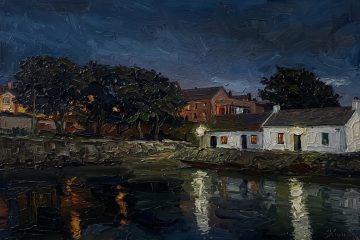
A picturesque coastal village well worth a visit is Carnlough. 34 miles from Belfast, it is situated in the barony of Glenarm Lower and the civil parishes of Ardclinis (Ard Claoininse – Height of the Sloping Island) and Tickmacrevan (Tigh MacCreabhan – House of MacCrevan). The small limestone harbour, quaint village and the stunning landscape of the foothills of Glencoy have long ensured Carnlough’s popularity with both locals and tourists.
The name Carnlough comes from the Irish Carnlach, meaning ‘place of the cairns’ or ‘lake of the cairns’. A cairn is an ancient stone funereal monument. There is archaeological evidence that this area has been settled from Neolithic times. In 1979, a Mesolithic (circa 7000BC) flint-making ‘factory’ was uncovered at South Bay Carnlough.
Phillip Gibbons
The First Carnlough Harbour
In the 1780’s the first harbour here was constructed by Phillip Gibbons. This was a stone-built pier 200ft long by 20ft wide, costing £1,200. It could accommodate ships up to 20 tons. The main exports were potatoes, grain and locally quarried limestone. Coal was the dominant import.
Arrival in Carnlough
Phillip Gibbons came from Westport in County Mayo and was the master of a smack, a traditional fishing boat. While anchored at the County Antrim village of Glenarm he met and married Ann Stewart. Ann was the daughter (some say god-daughter) of Nicholas Stewart, land agent for Alexander MacDonnell, 5th Earl of Antrim.
When Nicholas died in 1781, he left Ann the bulk of his estate (much to the displeasure of other family members). Phillip and Ann moved to live near the Curragh farm at neighbouring Carnlough, where she now owned lands. The couple resided at 58 High Street in the village.

“However the meeting occurred, it would appear Phil swallowed the anchor and came to live ashore. And so we have the son of a Roman Catholic land agent on the west coast of Ireland marrying the daughter of a Protestant land agent on the east, and the two living happily here together”
Jimmy Irvine Glynns Vol 10, 1982
Gibbons became a leading landlord in the district and important member of the Court Leet, what we would know as the local council. This convened in the upper chamber of the Glenarm Court House. He involved himself in various improvement schemes in the region including building and repairing roads and the building of the parish pound as well as the construction of the harbour.

‘The Sparrow Master’
From 1791-95 he was appointed to the unusual post of ‘Sparrow Master‘. At this time sparrows were a pest to farmers as they ate their crops, Gibbons was instructed to pay 1 shilling to any man who could produce a dozen dead birds.
Parish accounts reveal that Phillip Gibbons was a generous man, often donating money for the support of the poor in the neighbourhood and other worthy causes.
He died in March 1815 and was buried at Templeoughter Cemetery within the estate of Glenarm Castle.
Carnlough in the 19th Century
In the early 19th century, Carnlough consisted of 47 houses and 213 residents. By 1835 the village contained
“….53 stone houses, three-quarters of which are 1-storey high. They are mostly thatched and are of an indifferent description… Carnlough is rather improving, as a few tolerable 2-storey houses were built in the last year”
Ordnance Survey Memoirs April 1835
There were 6 annual fairs mainly for black cattle and sheep. The village had a corn mill and a flax mill. There was also a school run by the Methodist Society. It was composed of stone with a slate roof. Of the 110 pupils, 92 were Protestants and 18 were Catholics, 59 were boys and 51 girls. (During the plantation period the mainly Catholic population had been forced into the less productive mountainous areas of the parish).
The occupants of Carnlough were mainly small farmers or fishermen but the beautiful location also drew seasonal visitors.
“This place, originally a small fishing village, is pleasantly and advantageously situated between the bays of Cushendall and Glenarm, and from the fineness of its strand is much frequented during the summer months for sea-bathing”
Samuel Lewis Topographical Dictionary of Ireland 1837

By 1881 the population had risen to 634.
“It has one of the handsomest strands in the County, two miles in length, and is a favourite bathing place. Many families occupy lodges here during the summer months, and if the attractions of the district were fully known there would soon be a large addition to the number, and a necessity for increased lodge accommodation”
George Henry Bassett County Antrim, a Guide and Directory 1888

Frances Anne Emily Vane-Tempest
In 1834, at death of Lady Ann Catherine MacDonnell, 1st countess of Antrim, the Carnlough estate was inherited by her only child Frances Anne Emily Vane-Tempest.
Frances Anne had previously, on the death of her father, Sir Henry Vane-Tempest in 1813, acquired extensive lands in the north-east of England, including the Durham Coalfield. Her portion of the Antrim lands consisted of 10,000 acres between Glenarm and Glenariff. In 1854 she added to this by purchasing more land from the Gibbons family at Carnlough North.
Although mainly living in England or travelling abroad, largely to Russia or eastern Europe, Frances Anne took a keen interest in her Irish ‘property’ and required detailed reports and accounts from her land agents.
Improvement Works
The annual income from these estates alone came to around £2,500. To increase the revenue from her Irish holdings including the limestone quarries, she had a new enlarged harbour constructed and a railway from the works to the sea. This included a railway bridge over the main village street.
As well as a profitable export limestone ash was in great demand as a soil fertiliser.
“A great part of (Glencoy) being upon white limestone… here is plenty of firing to burn lime for manure”
Dean William Henry, Topographical Description of the Coast of Co. Antrim, 1740
The new harbour was built of limestone blocks and was completed in 1853. The builder was Patrick Mahon. It could accommodate ships up to 300 tons and its primary role was for the transport of limestone.
The railway opened the following year. Originally it ran for a mile and was operated by the Carnlough Lime Company. Later it was extended to just over 4 miles. The railway has long since been abandoned and is now a popular walking route from the Cranny waterfall to the village.
“She had a railway constructed at her own expense from the limestone quarries to the sea, at her village of Carne Lough, which underwent a complete transformation under the magic of her golden wand”
James Godkin Walkers handbook of Ireland 1873
Frances Anne Emily Vane-Tempest – Background & Family
Frances Anne was born in London on 17th January 1800. On 3rd April 1819 she became the second wife of Lieutenant Colonel Charles Stewart, who on the death of his brother Lord Castlereagh, became the 3rd Marquess of Londonderry. In accordance with her deceased father’s wishes, Charles Stewart added Vane to his surname. The couple had several residences – in the fashionable parish of St George Hanover Square in Middlesex, Holderness House in London and Wynyard Park in County Durham. Together they were fabulously wealthy and important figures in London’s ‘high society’.
Charles and Frances had a family of seven, 3 boys – George Henry (1821), Adolphus Frederick (1825) and Ernest McDonnell (1836). The 4 daughters were Frances Anne (1822), Alexandrina Octavia (1823), Hyacinthe Sophia (1826) and Adelaide Emelina (1830).
Support for the Poor
During the famine, Vane-Tempest sent money to her Irish agent, John Lanktree, to purchase clothing and blankets for her neediest tenants. In 1845 the Estate Clothing Society was established.
In March 1847 the Glencoy Relief Committee was set up to sell at reduced prices Indian meal to the starving poor.
Seeds were supplied and loans given to tenants to replace their thatched cottages with slate roofs and to paint the interiors, as whitewash has antiseptic properties. Women were encouraged to knit as a means of supplementing any income and an attempt was made to set up soup kitchens.

The Coaching House (Londonderry Arms)
In 1848 Frances Anne, Marchioness of Londonderry, had a coaching house costing £1,500, built on the main street in Carnlough. This was at the suggestion of Lanktree who wrote
“I would rather see £500 or £600 laid out in the building of a good hotel in Carnlough at which Your Ladyship could stop when you visit your Estates and which would still be paying a good return for the outlay besides inducing further improvements in the village”

This hostelry named the Londonderry Arms, passed down through the family and at one time was the property of Winston Churchill, Frances Anne’s great grandson.
Although sold in the early 20th century it has continued as a hotel and recently with new owners has been renamed the Harbourview Hotel.
An interesting story is told of the Londonderry Arms. In 1912, experienced hotelier Mary Anne Rafferty, moved from Belfast, firstly to Glenarm and then to Carnlough, to the Londonderry Arms.
Her father before her had owned the Bambridge Inn in Sugarhouse Entry (see post Sugarhouse Entry – Belfast’s Forgotten Lane). It was to this building that the recently deceased Henry Joy McCracken’s body was brought after his execution at the Market House in High Street in 1798.
Mary Ann McCracken had, in desperation, employed a doctor to try to resuscitate her brother. The corpse was laid out on a wooden table, but all attempts at revival failed. This table remained at the premises until Miss Rafferty had it transferred to the Londonderry Arms.
“The table was a popular topic of conversation in the hotel and Mary Anne Rafferty enjoyed recalling its history to interested visitors”
Felix McKillop Glencoy, a Local History
Unfortunately, the current whereabouts of this historic table is now a mystery.

Garron Point Residence
Design and Construction
A short way from Carnlough Frances Anne had a summer residence constructed at Garron Point. The location was chosen by Charles Campbell, a builder from Newtownards who had previously been employed by the family.
The location was on an elevated position some 200ft above the Antrim Coast Road. The land was previously leased by farmer Alexander McAllister and was near to the old fort of ‘Drumaul‘ – meaning the ‘the bag fort’ and is thought to be the place where the ancient Irish chieftains received the rent from their tenants. It was also built as a defence against Scottish incursions.
Frances Anne laid the foundation stone for Garron Tower on 24th February 1848. This large mansion with square towers and castellated battlements was the idea of Frances Anne herself, who envisaged a property in the style of the 14th century castle of Burg Rheinstein in Germany.
The house was completed in 1850 at a cost of £4,000. Lord Claredon, Lord Lieutenant of Ireland was present at the formal opening.
An extension, including an octagonal tower, was added in 1852 and was the work of English architect Lewis Vulliamy. While a front porch and gate lodge were built in 1854, an ice-house in 1856, stables designed by Charles Lanyon in 1860, and a dairy and vinery in 1861.
“The Tower of Garron is a castellated mansion, built after the style of the 15th century. The building forms two sides of a quadrangle, with a lofty octagonal tower, the East front upon the verge of a precipice overhanging the sea at a height of 270 feet”
Northern Whig 10th September 1850
Surrounding the house were extensive manicured grounds, while the mountain and sea views were awe-inspiring. In keeping with the ‘castle’ feel of the property, the seaward wall around the gardens had seven cannons. These are believed to be from the Napoleonic Wars. Frances’s husband Charles Stewart had served as an Adjutant under Wellington in the Peninsular War.

Garron Tower Interior
The inside of Garron Tower was expensively and sumptuously decorated and furnished. Craftsmen from Austria were brought over to carve the intricate wooden fireplaces, door panels and bookcases. A grand ornate staircase swept up from the spacious entrance hall.
Among the decorations was a painting by Rembrandt, valued in the 19th century at £10,000. On the first-floor landing was a large Gothic style stained-glass window depicting the Marchioness’s ancestor Henry Vane receiving a knighthood on the battlefield of Poictiers.
“This spirited and amiable lady who built, and occasionally occupied this mansion, gathered into it many rare and attractive articles of furniture, including a fine collection of family and other portraits”
George Hill, An Historical Account of the MacDonnells of Antrim, 1873
Every summer Garron Tower was the setting for lavish balls and extravagant dinner parties. Nobility from England and Europe were often in attendance.

Sale of Garron Tower
In 1899 Lord Herbert, grandson of Frances Anne, rented Garron Tower to Larne Hotelier Hugh McNeill (see post Galboly – The County Antrim Village Lost in Time). He eventually sold the building and 350 acres of land to the McNeill Hotel Group in 1915. The enterprising McNeill also owned a number of charabancs (horse-drawn buses) and ran trips for tourists along the north Antrim coast.

During the Second World War the grand old house was home for the old folk of Clifton House (see post Clifton House – Belfast’s Poor House), away from the risk of bombs in Belfast.
On 29th April 1941, with the help of the St John’s Ambulance Brigade, residents and staff were transported to this coastal retreat. Dr Elias Purdon from Belfast visited once a month and the general care was in the hands of the local GP from Carnlough.
St Killian’s School at Garron Tower
In 1947 Garron Tower was purchased by the Diocese of Down and Connor and in September 1951 opened as a school. The school, now known as St Killian’s continues to this day.
Other Carnlough Improvements
While only an occasional visitor to the area Frances Anne did try to improve her estate and the well-being of the locals. She had a school and townhall built and inaugurated a reading room and library in the village, as well as a temperance society, a dispensary and a savings bank.

To encourage productivity, she introduced farming competitions with cash prizes. In an attempt to have a ready labour supply, instead of depending on the seasonal availability of farmers, she had houses erected on Tempest Street (later changed to Herbert Street). These were constructed by a Larne builder at a cost of £95.
“If an economic return on her capital was always in her mind, so also was the welfare of her tenants”
Jimmy Irvine Glynns Vol 5 1977

Growth of Carnlough
By the end of the 19th century, Carnlough had a number of shops, a post office, a school and a Church of Ireland and a Catholic church. The post master in 1888 was John McSparron and the Harbour Master was James Foster. Mail coaches left twice daily from outside the Londonderry Arms.
Due to its coastal location, Carnlough obviously has strong links with the sea and this is reflected in the occupations of its residents. In 1901 John McCambridge is listed as a boat pilot and John Montgomery as an engineer on a steam vessel. Robert Leitch is a master mariner while, Thomas Moore, James Magill and Joseph Magill are A B (Able) seamen.
In the early 20th century, a number of steamers such as the Prase and the Sealight, and sailing ships such as the Mary Stewart were anchored at Carnlough harbour. These were Scottish trading vessels. So many sea-captains retired to Carnlough that a street was named Skipper’s Row.
Local Occupations
However, while some were farmers, the majority of Carnlough’s menfolk worked as labourers in the limestone quarries. We can imagine this was arduous and back-breaking work but it provided a stable income for many families including the Hamilton’s at 3 Carnlough North, the McVeigh’s at No 40 and the McKillop’s at No 12 Carnlough South.
Of the women, some ran grocery stores such as Martha Murry and Harriet Legge while others were seamstresses or dressmakers. However, most are listed as housekeepers or domestic servants.
The Gibbons family were still represented living at 25 Carnlough North.
“As long as anyone can remember, there has always been a Phil Gibbons in the village. Phil was the name handed down from father to son ever since the Gibbonses came to these parts”
Jimmy Irvine Glynns Vol 10 1982
The McAuley’s Bridge Inn

An interesting building situated in Carnlough is McAuley’s Bridge Inn established in 1912. The decorative Art Noveau exterior is a striking feature on Bridge Street. This was constructed on the site of an earlier McAuley’s public house that had been destroyed in a fire.
The original one-storey thatched building was used as the headquarters of the local United Irishmen in the 1790’s. After the failed Rebellion of 1798, the inn sheltered those revolutionaries ‘on the run’ until it was safe to return home of get a ship overseas.

Conclusion
We hope this brief ‘snapshot’ of Carnlough has prompted some interest in it’s history. The quiet village exudes a gentle, nostalgic vibe but comes alive with families and visitors over the summer months. It is to be hoped that the opening of the Harbourview Hotel brings more visitors and investment into this once-thriving location.

Before we leave, we must mention one notable Carnlough resident, Paddy the pigeon, who was awarded the Dickin Medal on 1st September 1944 for gallantry during WW2.

Related Posts

Sugarhouse Entry – Belfast’s Forgotten Lane

Galboly – The County Antrim Village Lost in Time

Clifton House – Belfast’s Poor House

Help Us Find New Readers
Belfast Entries is hobby website produced entirely by a retired husband & wife featuring articles on our shared history, memories and entertaining stories of our past. The stories are free to all. If you like our posts please help us to grow our readership by sharing the posts. A growing readership would be very much appreciated.
If you enjoy Belfast Entries please consider a small donation
If you wish to To help us meet website creation/ maintenance costs please click the coffee cup below to learn how to make a small donation. Please note that every contribution is valued and that we will acknowledge your contribution below (forename only or “Anonymous” if you prefer).

Donations this month 3
Thank you Damian
Thank you Sinead
Thank you R. Meharg
We had 2 donation last month.
Copyright Notice
Belfast Entries posts & photos are our intellectual property and copyrighted to us. Where we use photos that do not belong to us, it is because we believe them to be in the public domain or shared under a Creative Commons licence with appropriate attribution. None of our content or images can be used without our consent. Note that a link to our Copyright & Takedown notice is included in the website footer on all pages.




0 Comments