St John’s Church, the Hill of Donegore and the “End of the World”

Location
The church of St John’s is situated on the slope of Donegore Hill in County Antrim. One of the oldest Church of Ireland establishments in the diocese, it was built in 1659.
The townland of Donegore lies 5 miles east of the town of Antrim and 16 miles from Belfast. The hill itself is of important archaeological interest as well as being famous for its links to the 1798 Rebellion. It rises to a height of 768 feet and affords beautiful views of six counties as well as the Sperrin Mountains and Lough Neagh.
The name Donegore is said to come from the Irish Dun O gCorra, meaning the ‘stronghold of O’Corra’. However, other opinions claim the name stems from Dun-achar – ‘the sharp hill’ or Dun-a-gor – ‘the fort of the goats’. One rather interesting theory is mentioned in the Ordnance Survey Memoirs of 1838
“others say that Dun-a-gor signifies ‘the bloody fort’ and that this name was given it in consequence of it being the spot on which those attacked by some dreadful pestilence, which is said to have committed awful ravages in the country, were driven to die – to prevent the disease from spreading”.
Ordnance Survey Memoirs, 1838
Early Times
We know the first church on the site was a Catholic church. It was recorded in the taxation records of Pope Nicholas in 1306.
“Ecclesta de Duncurri: 15 marks
However, it was described as “in a decayed state” in the Ulster Visitation Book of 1622.
After the Reformation, the 17th century Protestant church was constructed. Subsequently, when the native Irish Catholics were ousted to make way for Scottish planters, the church became a Presbyterian place of worship. However, after the revolution in 1688, it was restored to the Established Church, that is the Anglican Church of Ireland.
“In the settlements which took place here, the original possessors of the soil seem to have been wholly extirpated, there being at present not the single trace of the aboriginal inhabitants; and within the last 10 years there was not a Roman Catholic landholder in the parish”
Lieutenant R Stotherd November 1832

Donegore Motte and it’s Antiquities
The location of St John’s is particularly fascinating as it sits in close proximity to Donegore Motte (Mote/Moat). This is an outcropping of basalt, originally conical in shape. Its distinctive appearance may have given it a ‘spiritual’ symbolism in prehistoric times. It certainly seems to have featured in funerial rites.
“Donegore motte is a natural outcrop of basalt; at some period in prehistoric times its summit was used as a burial place for cremated bodies, and recent excavations exposed small layers of these burials superimposed one upon another with earth between…..”
H C Lawlor Ulster Journal of Archaeology 3rd series Vol 2
Donegore Motte and the surrounding areas contain a number of souterrains. These are man-made underground chambers and passage ways. Usually, the sides and roof are lined with slabs of stone. The purpose of these subterranean structures may have been to act as ‘cold larders’ for storing food. Another explanation is that they were used to hide folk and valuables during times of attack.
“It is impossible to say how many exist in Ireland as they are usually hidden away in dense undergrowth or any other type of inconspicuous surrounding, therefore normally being discovered accidentally during ploughing or quarrying”
Robert Armstrong, Through the Ages to Newtownabbey
Many antiquities have been discovered in and around Donegore Motte and Hill. These include domestic items such as bowls, pottery, flints and axe-heads, hunting artefacts like polished arrow heads and personal possessions such as coins and beads.
“Finds from the site include 30,000 sherds of Western Neolithic pottery, a large quantity of both flint waste and artefacts, numerous fragments of porcellanite axes and about a half dozen beads and pendants. In addition to these Neolithic materials, one pit with the remains of two Early Bronze Age vessels has been uncovered”
Excavations.ie Database of Irish Excavation Reports.

The Motte Stronghold
In the 12th century, it is thought that this natural outcropping was utilised by the Anglo-Normans as a stronghold. Hence the French word ‘motte’ as it is now commonly known. The Norman Savage and Mandeville families settled in the area and Roger Fitzgerald held a ‘knight’s fee’ in Donegore.
“….as it is generally accepted an Anglo-Norman mote, adapted by them from an older structure, probably sepulchral”
D A Chart Preliminary Survey of the Ancient Monuments of Northern Ireland

Mottes were usually man-made mounds, but in this case, it is believed the Anglo-Norman invaders flattened the summit of the outcrop and transferred soil from the base to the top. The motte rises to a height of 120ft while the flat surface area at the top was 105ft by 85ft.
“The moat or dun was then visited, and the view from its summit much admired. This dun is partly natural and partly artificial and is extensively burrowed with souterrains”
F J Bigger, Northern Whig 8th September 1891
A defensive ditch would encircle the mound. The smooth top would accommodate a wooden fort. These forts or castles were usually called ‘baileys’. From here the Norman-English armies would have a good view of the surrounding countryside (see link below to the post on Roughfort, County Antrim).
“The region is dominated by the moat of Donegore. This fine earthwork is a conspicuous object in the landscape. It commands an extensive view over a rich and undulating country to Lough Neagh, with its expansive waters and boundary of distant mountains”

The Battle of Antrim
After the Battle of Antrim on 7th June 1798, a group of defeated United Irishmen retreated to Donegore Hill. Its panoramic views over the countryside made it of strategic importance.
“…..a small body known as ‘The Spartan Band’ under the command of James Hope….retreated in good order to Donegore”
H J St J Clarke, Thirty Centuries in South East Antrim 1938
Henry Joy McCracken, the leader of the Antrim contingent, attempted to rally his men but there were too few able-bodied rebels left to muster an attack. The men were forced to scatter and hide out in the hills.
“On the hill behind can still be traced the trenches thrown up by the United Irishmen in 1798 where they retreated to after their defeat at Antrim”
F J Bigger, Northern Whig 8th September 1891

1871 Renovation of St John’s
In the 1830’s the church of St John’s makes a rather bleak account in the Ordnance Survey Memoirs
“It stands east-west and measures externally 46 by 31 feet. The walls are 3 feet 6 inches thick. It is pretty well fitted up with pews, but it is cold, damp and comfortless. It contains accommodation for 120 people. It is in tolerable repair”.
However, in 1871 the church underwent a major renovation. The architect employed was Mr Boyd Esq of Donegall Square West, Belfast. The builders were Messrs McManus. The price of the undertaking was paid for by Mr Henry Adair of Loughanmore, at a cost of £1,600. A tower and belfry were added to the church building. A note in the minutes book records the purchase of coal and bog wood. So it seems the church had at least some form of heating at last, for which, I am sure, the parishioners were particularly grateful!
In 1875 the beautiful East Window was added. This depicts scenes from the life of Christ. It is inscribed
‘To the Glory of God and in memory of those who have departed this life in His faith and fear this window is erected upon the restoration of the Church A.D. 1875’


The End of the World
There is a quirky story associated with St John’s bell tower. Apparently, in the late 1870’s, two brown-clad monks appeared in the district. They roamed the countryside foretelling of a sudden disaster and the end of the world. The date for this event was 17th August and it would be heralded by the ringing of the church bell at Donegore.
Treated at first as superstitious nonsense, the message from these monks gradually produced a sense of unease in the neighbourhood.
The week leading up to the appointed date was hot and sultry. However, on the afternoon of 17th August, there was a sudden change. A haze rose up from Lough Neagh and a heavy bank of dark clouds appeared on the horizon. The area was enveloped in a dense mist.
We are told the reaction of local folk was two-fold. Some clutched their family around them and huddled indoors. Others gathered in a neighbour’s house for a ceilidh, to enjoy what appeared to be their last hours on earth.

At 10 o’clock a tremendous storm with howling winds and lashing rain broke over the region. It did indeed seem like the end of the world. Added to this were the frantic chimes of St John’s bell! The storm lasted for several hours and many of the bewildered people were terrified.
When at last calm came and morning broke, some local men ventured to the church on Donegore Hill. Here they found a poor dog with its tail tied to the extended bell rope! Someone in the neighbourhood had a peculiar sense of humour!!!! (The prank is reminiscent of the strange event at nearby Parkgate just a few years earlier – See Parkgate link below)
St John’s Church Today
The church today is little changed with the exception of two more stained glass windows installed in 1984. These 19th century windows featuring Our Lord and St Peter, were originally part of a private chapel in Loughanmore.
The pipe organ was a gift of St Brigid’s Church in Glengormley. It underwent restoration in 1982, paid for by the McKean family in honour of Mrs Isobel Mc Kean.
One of the oldest objects in today’s church is the stone font, believed to be gifted in 1825. However, the silverware of St John’s dates from 1681 and was made by John Phillips of Dublin. In 1693 it is recorded that John Phillips was the ‘master warden’ of the Corporation of Goldsmiths in the capital.

The Old Graveyard
Surrounding St John’s, enclosed by a stone wall, is the old graveyard with its interesting and evocative memorials. There is the mausoleum of the Adair family who often feature in the annals of the parish. A memorial plaque to the family also hangs in the church porch. One of the Adairs it records is Captain Charles William Adair who was killed aboard the HMS Victory at the battle of Trafalgar in 1805.

Facing the church door is the grave of Samuel Ferguson. Ferguson was a well-known poet and scholar. His family were of Scottish descent having emigrated to Ireland in the 17th century. Samuel was born in his granny’s house on High Street, Belfast on 10th March 1810. Although he trained as a barrister he loved literature and history. He was particularly interested in Ogham stones and translated the Ulster Cycle centring around the tales of Cuchulain. In 1867 he became the first Deputy Keeper of the Records of Ireland.
“To any man of intelligence the organisation of a new department must be of great interest. To Ferguson the work was fascinating”
Mary Catharine Ferguson
In 1878 Samuel Ferguson was knighted. Some of his poems include the Forging of the Anchor and Lays of the Wisdom of the Western Gael. In 1881 he was elected President of the Royal Irish Academy.

The Ferguson’s had a summer house in the shadow of St John’s Church. Sir Samuel Ferguson died on 9th August 1886 in Dublin.
“…all that was mortal of Sir Samuel Ferguson was conveyed to the family burying-ground in the County of Antrim. The procession to Donegore was accompanied by the Bishop of the diocese and many other mourners”


On the centenary of Samuel Ferguson’s birth, public events were held in his honour, including a wreath-laying ceremony at his graveside.

“The Corpse House”
In the south-west corner of the cemetery is the ‘corpse-house’. In times when body-snatching for medical research was a real threat, the remains of the deceased were stored here and guarded until they were no longer viable for dissection (see link to post Body Snatchers, Death, Resurrection Men and Murder). The antiquarian F J Bigger (see post Francis Joseph Bigger His Life and Times) mentions this corpse-house in 1891
“…the peculiar old vault that did duty in the times when medical students had some difficulty in procuring ‘subjects’ was carefully examined”

Donegore Hamlet
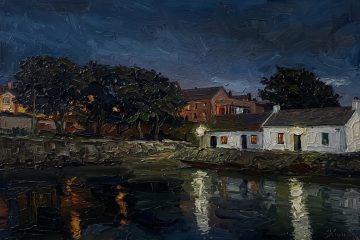
Close by St John’s Church is the picturesque hamlet of Donegore. It is really now only a few pretty houses. However, in the 19th century it was much larger
“Donegore consists of 4 two-storey houses and 7 one-storey cottages scattered irregularly in every direction within a few yards of the church. They are all constructed of stone and lime, and most of them are slated….they are occupied by two spirit dealers, one grocer, one schoolmaster and parish clerk, a sexton and six farmers. There are also several cabins and cottages scattered about the hamlet. They are occupied by agricultural labourers who are in rather poor in circumstances. There are about 100 inhabitants in Donegore hamlet”
Ordnance Survey Memoirs 1838

One of the current homes in Donegore bears the sign ‘Moat House’. This was originally a coaching inn and tavern. In the 1830’s a bye-road to Kells, Connor and Ballymena passed through the village and probably stopped here to change horses and for refreshments. An 1857 map shows the location of the school opposite the inn.

Conclusion
Today it is hard to believe that so much history is encompassed in this hidden nook. Donegore Hill from ancient times, through the turbulent 18th century, the concerns of body-snatching and the busy village of the 19th century has a wealth of stories to tell. Yet the tranquillity of the surroundings and the serenity of the old church and graveyard imbue the visitor with a sense of peace and leave history’s secrets untold.
Related Posts
Roughfort, County Antrim – One Location, Three Historic Tales

Parkgate Village – Early Days, Celebrity and an Unusual Event

Body Snatchers – Death, Resurrection Men… and Murder

Help Us Find New Readers
Belfast Entries is hobby website produced entirely by a retired husband & wife featuring articles on our shared history, memories and entertaining stories of our past. The stories are free to all. If you like our posts please help us to grow our readership by sharing the posts. A growing readership would be very much appreciated.
If you enjoy Belfast Entries please consider a small donation
If you wish to To help us meet website creation/ maintenance costs please click the coffee cup below to learn how to make a small donation. Please note that every contribution is valued and that we will acknowledge your contribution below (forename only or “Anonymous” if you prefer).

Donations this month 3
Thank you Damian
Thank you Sinead
Thank you R. Meharg
We had 2 donation last month.
Copyright Notice
Belfast Entries posts & photos are our intellectual property and copyrighted to us. Where we use photos that do not belong to us, it is because we believe them to be in the public domain or shared under a Creative Commons licence with appropriate attribution. None of our content or images can be used without our consent. Note that a link to our Copyright & Takedown notice is included in the website footer on all pages.
Help Us Find New Readers
Belfast Entries is hobby website produced entirely by a retired husband & wife featuring articles on our shared history, memories and entertaining stories of our past. The stories are free to all. If you like our posts please help us to grow our readership by sharing the posts. A growing readership would be very much appreciated.
If you enjoy Belfast Entries please consider a small donation
If you wish to To help us meet website creation/ maintenance costs please click the coffee cup below to learn how to make a small donation. Please note that every contribution is valued and that we will acknowledge your contribution below (forename only or “Anonymous” if you prefer).
Donations this month 3
Thank you Damian
Thank you Sinead
Thank you R. Meharg
We had 2 donation last month.
Copyright Notice
Belfast Entries posts & photos are our intellectual property and copyrighted to us. Where we use photos that do not belong to us, it is because we believe them to be in the public domain or shared under a Creative Commons licence with appropriate attribution. None of our content or images can be used without our consent. Note that a link to our Copyright & Takedown notice is included in the website footer on all pages.



0 Comments