Parkgate Village – Early Days, Celebrity and an Unusual Event

Introduction
Towns and villages in Ireland often have a ‘unique claim to fame’ or an unusual history to tell. However, for Parkgate the story is possibly the strangest yet!
Parkgate Village
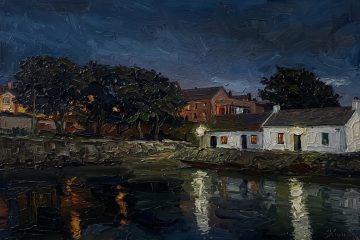
Parkgate is a little village in County Antrim in the Barony of Upper Antrim. It is 5 miles east of Antrim town and about 14 miles north of Belfast. The village grew up around the crossroads of the Antrim – Doagh and Templepatrick-Kells roads. It is situated near the south-west boundary of the parish of Donegore.

In earlier times, the Antrim Road was the main thoroughfare to the principal town of Carrickfergus. It traversed an extensive deer park, which extended 3 miles east to west and 2 miles north to south. This had been created by the Donegall family in the 1600’s as a recreation ground for riding and hunting. They also had a large lake excavated for fishing and boating. The entrance gates to the park were situated in the village giving Parkgate its name.
“A century ago the Lord Donegall of the time, laid out parks for deer and game of every description, and built a lordly lodge not far away, which he named Fisherwick, after his new English title of Baron, from that place in Staffordshire”
Belfast Telegraph 18th March 1924
Early Parkgate
Residents
In 1831, Parkgate had a population of 156 folk. The local landlord was William Ferguson Esq, uncle of the famous poet Samuel Ferguson.
His ‘gentleman’s seat’ was at Thrushfield in the nearby grange of Nilteen. The village consisted of 10 2-storey houses and 16 1-storey cottages, all built of lime and stone. Most of the homes had slate rooves but some retained the traditional thatch.
“The houses, being whitewashed and generally neat and clean, give the village a pleasing appearance which is improved by the trees in and about it, and the fertility of the surrounding country”
Ordnance Survey Memoirs Vol 29 County Antrim 1838`
By 1839 there were 3 grocers, 4 pub house keepers and a stamp office (post office) in Parkgate. Residents included 2 carpenters, 1 blacksmith, 2 old clothes sellers, 1 wheelwright, 2 watchmakers, 1 tailor and 1 cobbler.
Policing and the Courts
A police barracks, manned by 1 officer and 3 men occupied one of the thatched cottages in the village.
Petty sessions were held once a fortnight. In 1838 the sitting magistrates were Thomas Benjamin Adair of Loughermore and John Owens of Ballyvoy. In the years 1833-37, 878 summonses were issued for a range of offences including assault, breaches of the excise law and trespass. Of these 35 were serious enough to be forwarded to the quarter sessions court.
Parkgate Fairs
Fairs were held four times a year. The earliest on 7th February was a popular horse fair. Apparently 600-700 horses would be brought for sale. These were mainly for the farming community. The average price was £12. The fair was so renowned that often English and Scottish dealers would attend.
The later fairs on 7th May, 7th August and 4th November were for beef cattle, pigs and sheep.
“Some stalls of pedlar’s goods, old clothes, fruit and huxtery complete the fairs at Parkgate”
James Boyle Ordnance Survey Memoirs January 1839
The Presbyterian Meeting House at Parkgate
The only public building in Parkgate was the Presbyterian Meeting House built around 1735. A large plain stone building in a ‘T’ shape it was designed to hold a congregation of 1,000 from the outlying rural districts.
“It consists of a main aisle standing east and west, and measuring 65ft by 28ft… It is pretty comfortably fitted up internally with pews and has a spacious gallery, the entrance to which is from the outside by a flight of stone steps”
James Boyle Ordnance Survey Memoirs May 1838
The minister in the 1830’s was Mr Doherty who received an annual wage of £100 (Irish) from the government and £60 (Irish) from his parishioners.
A school was held in the session house of the Presbyterian church. Subjects taught were writing, reading, spelling, the classics, mensuration (geometry), book-keeping and moral education.
Schooling and Education
There was also a Sunday School. In total 100 pupils attended the local school, 61 boys and 39 girls. 90 of the children were of the Presbyterian faith, 7 were Protestants and 3 were Catholics. Each pupil paid from 2 shillings 6d to 7 shillings per quarter.
In 1834 a Book Club was established in Parkgate. This followed the trend in the area with the formation of the Doagh Reading Society in 1768 (see link below to the post ‘William Galt – Sunday School, Book-Burning & Rebellion‘]. This organisation for education and self-improvement had 35 members.
The residents of the village were mostly descended from Scottish emigrants, who arrived during ‘Plantation era’. This was the policy of supplanting the native Irish Catholic population with outsiders, mainly of the Presbyterian religion. These ‘planters’ would thus owe their livelihoods, and hence their allegiance, to the English crown.
“The names of the inhabitants of this parish would almost be a sufficient indication of their Scottish extraction. Those of Ferguson, Agnew, Boyd, Beck, Donald, Crawford, Sloan and Campbell are among the most prevalent”
Ordnance Survey Memoir Vol 29 County Antrim 1838
The Road to Rebellion
The Volunteers
During the troubled times of the late 18th century many young men from Parkgate joined the Donegore Volunteers.
“Most of the regular army in Ireland had been sent to deal with the revolution in America. Early in 1778 there was the possibility of a French invasion of Ireland. Volunteer corps sprang up spontaneously to defend Ireland and in 1791 the Lord Lieutenant allocated arms to them. By handing out weapons he greatly strengthened a movement over which he had no control: the Volunteers became an armed force recruited mainly from the Protestant middle class and led by landowners. In a short time there were forty thousand Volunteers, half of them in Ulster”
Donald Alexander The Parkgate Presbyterians 2011
On 1st July 1783, the Right Honourable Colonel John O’Neill of Shane’s Castle, delivered a sermon at Parkgate Meeting House, urging the need for political reform. Universal suffrage regardless of creed and the removal of the Penal laws were among the aims of the Volunteers.
The English authorities were becoming increasingly anxious about the growing power and influence of the Volunteers and in particular their more radical counterpart the Society of United Irishmen, founded in Belfast in 1791.
In 1793 the United Irishmen was declared an illegal organisation. Anyone suspected of being a member was arrested and imprisoned (see link below to the post ‘William Orr –Trial and Execution 1798‘). Subsequently martial law was imposed.
“The people of the Donegore district experienced martial law…. The patrol (of yeomanry) proceeded by way of the townlands of Ballyno, Scolboa, Ballywoodock and Dunamuggy, looking at every house they passed for the prohibited fire or light. None was seen until they arrived in Parkgate, when a light was observed in the public house kept by Mrs Young. The soldiers found eight men seated at a table with books and papers before them. The papers were regarded as compromising and the men were taken prisoner”
Donald Alexander The Parkgate Presbyterians 2011
Many men from the villages of Parkgate, Doagh, Ballyclare and Templepatrick were later to fight and die at the Battle of Antrim on 7th June 1798 for this worthy cause.

An Unusual Event
In 1870, unusual posters began to appear in Parkgate and throughout the district, including Browndod, Doagh and Templepatrick. The local ‘bill-sticker’, Paddy Baugh, was questioned about the strange announcement, but he denied all knowledge of the notices.
The posters declared
I will attend the Courthouse in Parkgate on 7th February
To purchase cats for the Peruvian government
From 10 shillings to 15 shilling each
Will be given according to size, colour and quality.
It was given to believe that Peru was over-run with mice hence the need for Irish cats. Also, that Peru was a country rich in gold and so able to spend freely.
We can imagine there was no other topic of conversation than the visit of the Peruvian minister to Parkgate! There was excitement, hopes and speculation. Some doubts too, surely, but these were outweighed by the dream of a few extra welcome shillings. The fact that the event was taking place at the courthouse added credence to the event.
The Great Cat Hunt
The story goes that every cat in the neighbourhood was rounded up. Both, strays and family pets were groomed on the best of meat, fish and cream to ensure they were top quality felines. Rumour had it that ginger tom cats would fetch the highest price. Some even thought if all went well, Bolivia, Ecuador and Chile might follow suit! A lively market in cat dealing emerged!
“The great round up began. Toms and tabbies were pursued and seized in the field and farm close, and, no doubt somewhat bemused were brought indoors to the warmth of the kitchen. They were fed on the bed of whipped egg and creamy porridge. The herring cadgers, on the high road, did a roaring trade.
Cats better acquainted with the toe of a boot than a brush, were perched on their owners’ laps to be combed and groomed ’till their fur shone. A feeling was growing through the townlands that to produce a ten shilling cat at the Parkgate Fair would prove to be a slur that no family could easily live down”
Sam Hanna Bell ‘Cats for Peru’
7th February – The Day of Reckoning
Before dawn had broken on the appointed day, Parkgate was filling up with locals from the surrounding areas all hoping to ‘make a killing’ on their cats. The town square had never seen anything like it, packed with carts and jostling pedestrians. The usual stalls of foodstuffs, poultry and second-hand clothes were pushed aside in anticipation of a lively cat auction!
“The old howie woman from Four Mile Burn was early afoot with her black triplets in an arm basket… There were others in carts and traps and panier creels, each holding on to something that was occasionally audible though never musical”
Francis Joseph Bigger Belfast Telegraph March 1924

By lunchtime, no cat buyers, Peruvian or otherwise, had arrived. Some folk settled down with their ‘pieces’ (sandwiches) or soda farls while others retired to the inn for a wee dram.
Twice top-hatted men were spotted on the road leading to Parkgate, but these turned out to be false alarms and not the ‘Señor from Peru’.
“Eventually the truth dawned on the assembly that they had been hoaxed. Many angry words were heard as over 1,000 well nourished cats were released from their containers on Parkgate”
Robert Armstrong, Though the Ages to Newtownabbey, 1979
Of Cats and Newlyweds
After the ruckus and disappointment had died down, rumours began to fly as to who were the perpetrators of the trick.
Suspicion fell on a group of young men known for pranks. They were Thomas Aitchison, a blacksmith, William Ellison, William Jameson, Archibald Ferguson and James Mc Niece all farm workers. McNiece from Dunnamuggy being the ringleader.
Shortly after the ‘cat fair’ Thomas Aitchison was married. His bride was Kitty (appropriate!) Lavery. After the ceremony the newlyweds returned to their thatched blacksmiths cottage in Parkgate.
It was a stormy night when the ‘avengers’ quietly barricaded the door and windows of the little cottage. Cautiously, one man climbed the thatch, as he reached the roof-top a large container was passed up to him. He then proceeded to empty dozens of confused and angry cats down the chimney! Pandemonium ensued – certainly a wedding night to remember!

“Jersey Lily”
In the late 19th century Parkgate was one of the homes of the wealthy Langtry family (see link to post ‘Fortwilliam Park and its Rich History‘). Edward Langtry and his wife, the famous ‘Jersey Lily’ Langtry lived for a time on their 340-acre Parkgate estate.

Lillie stabled her thoroughbred racehorses here. Her champion horse, St Saviour, is recalled in the St Saviour Gate housing development in the village.
The notoriously extravagant couple subsequently relocated to London. After her divorce Lillie had a notable stage career.

Development of Parkgate
By the turn of the 20th century, there were around 70 folk living in Parkgate. Of these 6 were Catholic and 6 were Methodist, the rest Presbyterian.
Joseph Crawford a bootmaker lived at No 3, James Smyth at No 7 was a publican and James Skelton of No 19 was a postman. The schoolteacher Susan Megaw, was boarding with the Hunters at No 20. Other occupations were blacksmith, merchant, agricultural labourers, drapers and Thomas Jamison who described himself as a ‘rancher’.
Parkgate Today
Today the main street of Parkgate is little changed and the village atmosphere remains. A number of housing developments have brought new life blood into the area. A reasonable commute into Belfast while having the advantages of a rural setting, make the village popular with families.
As to the number of cats, that is anyone’s guess!!


Related Posts
William Galt – Sunday School, Book-Burning and Rebellion

William Orr – Trial and Execution 1797

Fortwilliam Park and its Rich History

Help Us Find New Readers
Belfast Entries is hobby website produced entirely by a retired husband & wife featuring articles on our shared history, memories and entertaining stories of our past. The stories are free to all. If you like our posts please help us to grow our readership by sharing the posts. A growing readership would be very much appreciated.
If you enjoy Belfast Entries please consider a small donation
If you wish to To help us meet website creation/ maintenance costs please click the coffee cup below to learn how to make a small donation. Please note that every contribution is valued and that we will acknowledge your contribution below (forename only or “Anonymous” if you prefer).

Donations this month 3
Thank you Damian
Thank you Sinead
Thank you R. Meharg
We had 2 donation last month.
Copyright Notice
Belfast Entries posts & photos are our intellectual property and copyrighted to us. Where we use photos that do not belong to us, it is because we believe them to be in the public domain or shared under a Creative Commons licence with appropriate attribution. None of our content or images can be used without our consent. Note that a link to our Copyright & Takedown notice is included in the website footer on all pages.



0 Comments