Portaferry – A History

Introduction
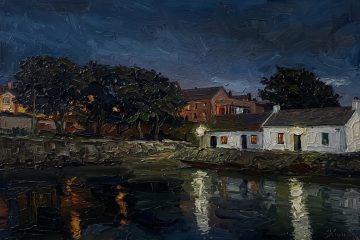
Portaferry is situated at the southern end of the Ards peninsula in County Down, about 30 miles from Belfast, on the shores of Strangford Lough.
Its name ‘Port an Pheire‘ literally translates as the ‘landing place of the ferry’. A regular ferry service operates daily covering the 1,500 metres between Portaferry and Strangford on the opposite side of the lough. This region in the barony of Lecale has been named an area of outstanding natural beauty.
“Portaferry deserves to be classed among the most charmingly picturesque places in Ireland”
George Henry Bassett, County Down, a Guide and Directory 1886

In the 12th century the Anglo-Norman Savage family settled here. The clan of Le Sauvage came from Normandy with the army of William the Conqueror and settled in Derbyshire. They arrived in Ireland in the entourage of John de Courcy, the successful military adventurer.
“….in 1177, they established themselves in Ireland in the person of William Savage, one of twenty-two Knights who fought by De Courcy in the subjugation of Ulster, and subsequently one of the Ulster Palatine Barons”
G F Savage-Armstrong, The Ancient and Noble Family of the Savages of Ards, 1888
In 1400 the English king Henry IV, appointed Robert Fitzjordan Savage to the post of Sheriff of the Ards.

A descendent, William Le Savage, in the early 16th century had a stone castle, or tower house, constructed overlooking the bay at Portaferry, in the townland of Ballyphilip. It was square in shape with 3 storeys and an attic connected by a wooden spiral staircase. There was a projecting turret to the south with a machicolation arch to defend the entrance. Another doorway was protected by a murder-hole.

“….and the place being well secured and garrisoned by that powerful family [the Savages], its situation on the strait made it a post of great importance in all the subsequent wars, during which neither it nor the neighbouring district of the Southern Ards ever fell into the hands of the Irish”.
Samuel Lewis, Topographical Dictionary of Ireland, 1837

A further royal indenture in 1538 reinforced the ascendancy of the Savage clan
“Raymond (Savage) should have the chieftainship and superiority of his sept in the Territory of the Savages, otherwise called Lecale”
In 1559 Sir Deputy Wiliam Fitzwilliam settled a dispute by dividing the Ards peninsula between two rival factions of the Savage family. Raymond Savage acquired the Ardkeen portion and Roland Savage the Portaferry estates. Roland Savage took to styling himself ‘Lord of Little Ards’. When he died in 1572, the castle passed to his eldest son Patrick. The Savages of Portaferry were traditionally buried in the old graveyard at Downpatrick.
Attached to the castle today is a later stable block and coach house. The castle was inhabited by the Savage family until 1765. Although now in ruins the castle still remains an impressive sight in Portaferry.
Portaferry House
In the mid-18th century Andrew Savage had a new family home constructed.
Portaferry House is a large impressive mansion built in the Georgian style. It was designed by Dubliner William Farrell. The central doorway was flanked by Ionic columns and end piers. On either side were wide 3- sided bows.
The house was extended in 1790 and again in 1818 with money won in a bet with Robert Stewart of nearby Mount Stewart. The enlargements were designed by Charles Lilley of Dublin. The work was completed in 1820 at a cost of £7,140.
The entrance hall featured a black marble fireplace, Persian carpets and featured a grandfather clock with a painted dial by Richard Campbell of Portadown. An unusual decoration were two large elephant jaws and spinal columns (not to today’s tastes!)
The extensive gardens around the property included parklands, woods, lakes, manicured lawns and pleasure grounds. Also, within the estate were walled fruit gardens, stables, kennels, farm buildings, a threshing mill and 3 gate lodges.
“Portaferry House, the residence of General Nugent, stands in a beautifully wooded demesne on the verge of the town, and commands a fine view of the Lough”
‘The Nugents’
Andrew Savage was a captain of the ‘Infantrerie de Hibernia‘ in the army of Philip V of Spain.
In 1814 he changed the family name to Nugent when he became one of the benefactors of the estate of his great uncle Governor John Nugent of Westmeath. This did not please all family members however, as one elderly uncle is heard to remark I would “rather be an old Savage than a new gent!”
The Nugent/Savage family continued to reside in the 13-bedroomed Portaferry House set in 676 acres until the 20th century.
However, when Patrick Edmund Nugent (aged 22) died in action on 27th April 1943 in Tunisia and his brother John Andrew Nugent (aged 19) was killed on 2nd October 1944 in Italy, the family died out. Both lads were lieutenants in their father’s old regiment the Grenadier Guards. When their mother Cynthia Maud Nugent (nee Ramsden) passed away in 1986, the grand old house was sold and converted into apartments.

The Development of Portaferry
In the 18th century Portaferry was described as merely a collection of cottages clustered around the castle. However, by the 1830’s, apparently due to the endeavours of the landlord, Portaferry was developing into a busy town with three main streets and stone-built merchants houses at the quayside.
“It is now, owing to the exertions of the proprietor Andrew Nugent Esq., and the spirit of commercial enterprise in the principal townsmen, a place of considerable business, and increasing yearly in prosperity”
Samuel Lewis Topographical Dictionary of Ireland 1837

The Market House
The main public building was the Georgian Market House. This was completed in 1752 in the town square and was adorned with the Savage coat-of-arms. It is the oldest surviving building in the town. It had 2-storeys and measured 44ft by 21ft.

As well as a market the building served as a manor court where debts up to the amount of 40 shillings were settled. Additionally, a court leet was held here once a year to appoint a grand jury, petty constables and for deciding local tariffs. (A ‘court leet’ was an Anglo-Norman court with jurisdiction over minor offenses, land, and the election of local officials)
Markets were held in Portaferry every Saturday and there were annual fairs in January, February, May and November.
The 1798 Rebellion
During the 1798 Rebellion, the building was successfully defended by the local yeomanry when it was attacked by the United Irishmen.
Other Market House Activities
Over the years it has also hosted a variety of gatherings and entertainments.
The upstairs rooms housed the library of the Literary Society and the Mechanical Institute. The Penny Bank, Portaferry’s first bank operated from the Market House as did a reading room.
The central room also occasionally acted as a ballroom. Or more often for hosting tea parties given by the Temperance Society when the room was decorated with green leaves.
“The town is neat and contains some good houses. The gentlemen’s residences are mostly along the shore, some of which are large and handsome for the size of the town”
Ordnance Survey Memoirs, 1836

Continued Portaferry Growth
By 1837 the inhabitants of the town numbered 2,203. Most earned their livelihood by fishing.
In the harbour were 8 registered ‘luggers’. These are small working boats with asymmetrical 4-cornered sails known as lug sails. These were used to fish the herring and mackerel grounds. There were also around 20 rowing boats which caught codling, whiting and lobsters.

In the 19th century shipbuilding was a major industry in the town. In connection with this was also a ropeworks which existed until 1875.
“For a century or so it was a busy thriving coastal town, full of master mariners, ship-owners, ship-builders, rope-makers, and ships’ chandlers. Its fishermen, too, flourished: sand smelts were sold in Belfast as ‘Portaferry chicken’” (A sand smelt is a small ray-finned fish usually found in estuaries or harbours).
Portaferry and Strangford Ulster Architectural Heritage Society, 1969

The harbour, owned by the Nugent family, was kept busy exporting wheat, barley, oats, potatoes and kelp mainly to Liverpool and Glasgow as well as Dublin and Belfast. The main imports were timber and coal.
However, with the development of larger steamships requiring deeper waters Portaferry harbour fell into decline.
The Salt Pans
Another employment in this coastal town was the Salt Pan works. Here salt was extracted from seawater. The brine was collected in large shallow pans and left to evaporate in the heat of the sun in summer and by fire in winter. The salt crystals could then be used in industry and in food preservation.
In 1763 Patrick Savage leased land on the shoreline to local businessmen William Galway, John Reed and James McCleery for salt production. The site is now a housing development named the Salt Pans.

Business and Residents of Note
Portaferry also boasted a police station, a coast guard station and a hotel in the square described as “small but good”.
There was also a distillery owned by a Mr John Maxwell. It was powered by a water wheel 14 ft in diameter. The whiskey was sent to Belfast and Downpatrick, though it was noted “a considerable portion is sold in the town”.
There was also a bleach green for linen, a tanning plant and a tobacco factory.

A school educated the local children. The schoolmaster was paid £20 a year. There was also a dispensary run by a Dr A Dunne and a chemist. There were several drapery businesses including those of Mrs M Caughey and S McCausland, and a number of grocery stores and spirit merchants. F Berginger was a jeweller and watch-maker, H Ellison a saddler, J McCausland a timber merchant and Hugh Brown a victualler.
“The town has a clean and cheerful appearance, and is prospering, the inhabitants being an industrious and intelligent class of people”
William McComb, Guide to Belfast and the Adjoining Districts, 1861
Portaferry also had a cricket club. In 1886 Mr R F Parks was secretary and Mr F H O’Ryan the treasurer. Every summer the town also held a regatta for sail and row boats. Every July Portaferry still holds a week-long maritime gala festival.

A coach left the town every morning at 5am to travel to Belfast, the fare was 2s 6d. The mail car arrived at 3pm.
By the end of the 19th century the town was supplied with gas, Mr Robert Smith being the manager of the gasworks. Fresh water was piped from local springs into conveniently placed fountains.
In 1891, Thomas Somerset from County Down founded a linen manufacturing business. As well as factories in Belfast and Greyabbey, he established premises in Portaferry.
“…the firm of Messrs Thomas Somerset & co who already own factories in Belfast, Portaferry and Greyabbey. In those three factories upwards of 1,200 workers are employed, a number which testifies to the enterprise with which the business is conducted and the extent of its ramifications”
Belfast Newsletter, 24th February 1915
Here he employed many women to embroider handkerchiefs. In order to increase productivity during the winter months, Somerset had an electric light fitting and one bulb installed in the house of each of his employees. In 1914 the Somerset Company offered to provide electric lighting for the streets of the town.

William Steel Dickson and the Presbyterian Church
Perhaps Portaferry’s most notable citizen was William Steel Dickson (see link below to the post ‘William Steel Dickson – Confinement and Exile‘). He was the Presbyterian minister here in the 18th century.
The current Presbyterian church on the site was erected in 1841 under the guidance of the Rev John Orr. His interest in the Classics is reflected in the building’s Greek Revival style with its triangular pediment and six grand columns.
“It is a quite remarkable exercise in a severe and simplified Doric style of the geometric style…..”

The church was designed by Belfast man John Millar and is believed to be based on the Temple of Nemesis on the island of Rhamnous. Miller, whose brother was a Presbyterian minister, was responsible for several Presbyterian churches including those in Rosemary Street, Castlereagh, Antrim and Crumlin. His offices were in York Street, Belfast before he emigrated to Australia.
The church took 2 years to construct and cost £1,999 12s 6d. It was officially opened on 2nd September 1841 by the evangelical minister Dr Henry Cooke.
This building, while still in use by the local Presbyterian congregation is now owned by Portico Ards Ltd and is an entertainment venue hosting a variety of musical, comedy and theatrical performances.

Patrick McManus
One forgotten native of the Portaferry district is the poet, Patrick McManus. Patrick was born in 1863 at Keaney, a small group of cottages near Portaferry. Son of a carpenter, he attended Ballyphilip National School.
From an early age he was publishing poetry in the local newspapers under the pseudonym ‘Slieve Donard’. Subsequently, his work also appeared in The Weekly News, Young Ireland and Dublin-based The Nation.
In 1884 Patrick went to work in Belfast, but city life was not to his liking and he soon returned home. However, in early spring of 1886, like so many others, Patrick left Irish shores to join his brother in Philadelphia. His poems speak of his love for his homeland. Sadly, in August of the same year he passed away, he was only 23.
I would rather live in Ireland
Patrick McManus
And the thought comes from my heart,
I would rather toil in Ireland
On the barest, bleakest part,
Spurned by every village magnate,
Smote by every minion’s hand,
Than abide in pomp and panoply in any other land.
Joseph Tomelty

In more recent times Portaferry is famous as the birthplace of the actor and playwright Joseph Tomelty. The Tomelty’s were a musical family living in a little terraced cottage facing Strangford Lough. Joseph was born on 5th March 1911, the eldest of seven children.
As well as preforming on stage and radio, most notably in The Cooeys, Tomelty was also an author. However, he is probably most well-known for his roles on the silver screen in the 1950’s and 1960’s including Odd Man Out (1947), Hobson’s Choice (1954), Moby Dick (1956) and A Night To Remember (1958).


Portaferry Today
Portaferry, on the beautiful shore of Strangford Lough is a lovely and exceptionally friendly place to visit. An important attraction in the town is the Exploris Centre an aquarium and seal sanctuary. This is the only aquarium open to the public in Northern Ireland. The attractive location and historic background only add to the charms of this welcoming town.

Related Post
William Steel Dickson – Confinement and Exile

Help Us Find New Readers
Belfast Entries is hobby website produced entirely by a retired husband & wife featuring articles on our shared history, memories and entertaining stories of our past. The stories are free to all. If you like our posts please help us to grow our readership by sharing the posts. A growing readership would be very much appreciated.
If you enjoy Belfast Entries please consider a small donation
If you wish to To help us meet website creation/ maintenance costs please click the coffee cup below to learn how to make a small donation. Please note that every contribution is valued and that we will acknowledge your contribution below (forename only or “Anonymous” if you prefer).

Donations this month 3
Thank you Damian
Thank you Sinead
Thank you R. Meharg
We had 2 donation last month.
Copyright Notice
Belfast Entries posts & photos are our intellectual property and copyrighted to us. Where we use photos that do not belong to us, it is because we believe them to be in the public domain or shared under a Creative Commons licence with appropriate attribution. None of our content or images can be used without our consent. Note that a link to our Copyright & Takedown notice is included in the website footer on all pages.



0 Comments