A Battle of the Giants and Washington in Flames – Picturesque Rostrevor

Rostrevor Location
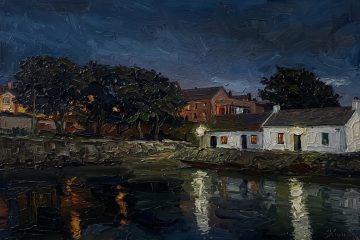
Rostrevor is a village in County Down, 46 miles south of Belfast and 9 miles from Newry. Its picturesque setting on the shores of Carlingford Lough with the back drop of Slieve Martin make it a lovely place to live and visit. The river Kilbroney runs through the village. The area is home to myths and legends that only add to its charm. It is hard not to be enchanted by Rostrevor.
The settlement sits in the townland of Rostrevor, but the region was originally known as Carrickairaghad meaning ‘silver rock’. From at least the 12th century this was the patrimonial territory of the Magennis clan, lords of Inveagh. Their principal seat was at Caislean Ruiari, that is Rory’s Castle. Unfortunately, nothing remains of this mighty castle today
Edward Trevor
Naming of Rostrevor
When Welshman Edward Trevor acquired the land in the 17th century, he changed the name to Rostrevor after his family. Ros, in Irish means ‘wooded headland’.
Edward Trevor was born c1580 to Robert Trevor and Katherine ap Llewellyn from Denbighshire in Wales. The Trevor’s were an ancient line descended from Tudur Trevor, King of Gloucester who lived c940, and Angharad, daughter of Hywel Dda, King of Wales. They had a reputation as a warring family, frequently involved in feuds with their neighbours, though this was not unusual for the times.
Military Exploits and Career
As a young man, Edward joined Edward Blayney of Gregynog’s expedition to Ireland to avenge the defeat of English forces at the Battle of Yellow Ford. On 14th August 1598, Hugh O’Neill had routed the English army led by Henry Bagenal, who were on their way to relieve the siege at Blackwater Fort.
The extensive losses and the surrender of this important fortification, led to an escalation in the Nine Years War with England increasing their forces, including the Welsh contingent, sent to Ireland. By contrast O’Neill allowed the defeated English soldiers to leave, so long as they left behind their ammunition, and tended to the wounded men until they were fit to travel.
Trevor continued his military career in Ireland and was commended for gallantry in 1600. In 1612 he married his second wife Rose Ussher (his first wife, Anne Balle, had died in 1610). Rose was the daughter of Henry Ussher, Archbishop of Armagh, and Mary Elliott. Some historians have suggested that the town’s name came from this union – as Rose Trevor.
Trevor was instrumental in the Plantation policy of settling Protestant immigrants on Irish lands to secure Ireland for the English crown. He ‘planted’ numerous English families in the area around Malone and Stranmillis in County Antrim, near the hamlet of Belfast.
Edward still held land in his native Wales (some 1,400 acres). In 1612 he built Brynkynallt Hall at Chirk, near Wrexham. This 3-storey mansion is believed to have been designed by the famous London-born architect Inigo Jones.
Edward Trevor having acquired the estate in south county Down, was knighted on 5th November 1617, by the Lord Deputy Sir Oliver St John. Trevor’s political career was furthered in 1623 when the English king, James 1, appointed him to the Irish Privy Council and in 1634 he represented Newtown (Newtownards) in the English Parliament. However, during the uprising of 1641, Sir Edward Trevor was captured by Irish rebels. He died soon after his release in May 1642.
Edward was succeeded by his sons, one of whom, Marcus Trevor was acclaimed 1st Viscount Dungannon in 1660.

The Tale of Saint Bronach’s Bell
That Rostrevor is an ancient settlement is shown by its connection with Saint Bronach (Bronagh).
Bronach was a disciple of St Patrick. She established a convent in the valley of Glen Sechis, near Rostrevor. This contained a hospital for shipwrecked sailors who were washed ashore on the banks of Carlingford Lough. When stormy weather was expected the nuns would ring the convent bell as a warning to sailors and fishermen. The name of the parish, river and woods – Kilbroney come from the name of the religious establishment Cell Bronche.
The convent bell itself, has an interesting story.
It is said that one day a young chieftain named Fergus and his warriors were hunting deer in the Mourne Mountains. When a ferocious storm occurred, they took shelter in a cave. While waiting for the rain to abate, Fergus spotted a magnificent stag and with his favourite wolf-hound, set off in pursuit. However, the animal was also being hunted by Artan, chief of Lecale, Fergus’s bitter rival.
In the ensuing attack, the stag gored Artan’s hound. Artan threw his spear at the deer but missed and killed Fergus’s dog. In revenge, Fergus drew his bow and fatally wounded Artan.
When his temper had cooled, Fergus deeply regretted his impulsive action. In reparation he employed the finest local craftsmen to hammer an iron bell which he presented to St Bronach’s convent.

In a postscript to this legend, it is said that after 50 years travelling as a pilgrim to atone for his sin, Fergus returned to his homeland. Here he met an old man, who turned out to be Artan! The wounded chief had not died, but had been nursed back to health by some shepherds. The two old enemies embraced and Fergus, at peace at last, fell dead in Artan’s arms.
(We are indebted to www.thelastleprecaunsofireland for this story. Visit this site for many more tales).

A large Celtic High Cross marks the grave of St Bronach in the old cemetery, it is made of Mourne granite. Bronach’s feast day is 2nd April.
Due to its location not far from the shores of the Lough, the convent was subject to attacks from marauding Vikings. In the 15th century a new church dedicated to St Bruno was constructed on the site of the old convent. During the English Reformation and in Cromwellian times anything of value was ‘confiscated’ and the church was left derelict. The remains of St Bruno’s can still be seen in Kilbroney graveyard.

However, for years locals still claimed to hear the old bell ring out over the valleys on windy nights. During a storm in 1885, an ancient ivy-covered oak tree growing in Kilbroney churchyard was felled. Among its branches was found a bell dating from 900AD. It is believed this was the old bell belonging to the convent, hidden by the nuns to prevent it being taken by English soldiers. Today this bell is housed in Rostrevor’s Catholic Church, St Mary’s, Star of the Sea.

Thomas Dunn – United Irishman
One son of Rostrevor who deserves to be more widely known is Thomas Dunn. An enlightened educationalist, he believed in the principles of equality and freedom regardless of class, nationality or creed.
In Penal times Catholic children were not permitted a Catholic education. ‘Popish’ teachers were forbidden. Hence, what is known as ‘hedge schools’ arose. Catholic teachers would educate the young in secret, in sheds, by hedges, in sheltered valleys or ‘safe houses’. If caught the teacher would be imprisoned.
One such teacher was Thomas Dunn. He taught Catholic and Presbyterian (Dissenter) children in his barn. He also read to young and old alike the writings of Tom Paine and Wolfe Tone and from the radical newspaper the Northern Star. He translated the works into Irish so that the peasantry could understand.

Dunn espoused the values of the French Revolution and became a United Irishman in the hopes of attaining a more just society for all the people of Ireland.
However, after the failed attempt of a French force landing at Bantry Bay in 1796 the English government was determined to stamp out revolutionary fervour in the island. In the north the ‘Dragooning of Ulster’ was a brutal and merciless attempt to wipe out any ideas of liberty and equality. To disarm the people and leave them broken, down-trodden and easily governed.
In 1797 Dunn’s barn was raided. When 62-year-old Thomas refused to reveal the names of his fellow United Irishmen, he was flogged. Thomas Dunn suffered 260 lashes of the whip before he died. He never disclosed any names.
Thomas is buried in the local cemetery of Kilbroney, a brave man, a patriot and a true hero for all who believe in freedom and equality.

“Tom knew the power of education. Through his hedge school and evening recitations of scholarly books, he enlightened the poor and oppressed and helped to move people towards a more integrated, cohesive and shared society”
Rostrevor, Town Square Information Board
The Cloughmor Stone
One of the famous landmarks close to Rostrevor, is the 50-ton granite boulder – Cloughmor (or Cloughmore). Cloughmor is Irish for “Big Stone.”


The ‘Big Stone’ sits 1,000 feet above Rostrevor on the slopes of Slieve Martin. This region is a designated National Nature Reserve and an Area of Special Scientific Interest. It is thought that the stone was left behind when the ice age glaciers retreated some 20,000 years ago though many prefer the tale below.
Finn McCool and the Cloughmor Stone
A more interesting explanation for the boulder’s presence is that it was thrown by the legendary giant Finn McCool (Fionn mac Cumhaill in Irish). After an epic three day battle with Ruiscairre, the god of Ice and Water, Finn hurled the rock from the other side of Carlingford Lough to hit his fearsome adversary .
It is said that Ruiscairre still lies buried beneath the boulder. Locals say that if you walk seven times around Cloughmor, it will bring you good luck (Ruiscairre would probably not agree!).

Major-General Robert Ross
A notable resident of Rostrevor was the British army officer Major-general Robert Ross. He was born in the village in 1766, the son of David Ross and Elizabeth Adderly. Following in the family tradition he joined the army in 1789. A friend of the Duke of Wellington (who was also born in Ireland), he served in the Peninsular Wars against the forces of Napoleon.

The American War of Independence – Washington in Flames
In 1814, during the American War of Independence, Ross led the English troops to victory at the Battle of Bladensburg against the American militia.
Subsequently, a 4,500 strong British force marched on and captured the American capital Washington. Public buildings, including the U S Capitol were set on fire.
It is said that Ross himself, entered the President’s home (the forerunner of today’s White House) from which President Madison fled. He purportedly consumed Madison’s unfinished breakfast before the building was set ablaze.

The Ross Monument
On 12th September 1814 however, Ross was fatally shot at the Battle of Baltimore. His remains were buried at Halifax, Nova Scotia but a large monument was erected to him in his home town.
The Ross memorial is situated on the shores of the Lough. The 100-foot obelisk is composed of native granite, and was paid for by local subscriptions. It was erected in 1826.


“One of the principal attractions in the neighbourhood is a graceful obelisk to the memory of General Ross of Bladensburg – a distinguished officer in the last American war (1812-1815)”
William McComb, Guide to Belfast, 1861


Early Days of Rostrevor Village
Population and Commerce
In the 1830’s Rostrevor was described as a neat and clean village, centred around Market Street which ran for 620 yards and Post Office Street, 155 yards. There was no lighting or police station.
The mail arrived daily at 5:30am and 4:00pm and was despatched at 11:30am and 8:30pm. Markets were only held in the summer months but there was a fair on the first Tuesday of every quarter for livestock, potatoes, meal, linen and yarn.
“In the town are the following buildings; a church, a Roman Catholic chapel, an hotel, four school houses, a post office, a bridge and several good houses, among which are the residences of Lady Lifford, Admiral Woolsey, Smythson Corry esquire, Mrs Fosbury. The town consists of 93 two-storey houses, 29 cabins and 2 principal streets”
J Hill Williams, Ordnance Survey Memoirs, October 1836

Lady Lifford was the last descendant of the Trevor line. Her villa was located on the site of the family’s original castle.
In 1836 Rostrevor was home to 1 innkeeper, 9 grocers, 5 spirit dealers, 4 haberdashers, 1 nailor, 4 carmen, 3 bakers, 4 tailors, 4 shoemakers, 10 carpenters, 3 blacksmiths, 1 wheeler and 4 butchers. There was also the Rostrevor Lending Library for lending books to the poor “the collection consists entirely of moral and religious books”.
The 1858 Directory records
“The town is delightfully on a gentle declivity, which rises from a little cove of Lough Carlingford, and commands beautiful views of the woods, mountains and waters of the lough’s basin”.

Rostrevor is one of the most charming little bathing places that can be imagined , wanting only strength of water to make it perfect . It is delightfully situated at the head of a small cove running off Carlingford Lough . The road to it from Warrenpoint runs along the shore , and the number of pretty villas along the shore shows how well the attractions of the locality are appreciated by the merchants of Newry . About midway a very fine obelisk has been erected to the memory of Gen. Ross , who fell victorious at Baltimore .
James Godkin, Walker’s Hand-book of Ireland, 1873
In 1881 the village of Rostrevor had a population of 706. It had a Presbyterian, Church of Ireland and Catholic Church. It seems to have been a desirable residential location, described by George Henry Bassett in his book County Down, 100 Years Ago, published in 1886 as –
“Handsomely planted lawns and private residences, indicative of taste and luxury, are numerous in the vicinity, and there are good hotels and recreation places”
George Henry Bassett, County Down, 100 Years Ago, published in 1886
The hotels listed in the directory are the Mourne and the Woodside. The Mourne later became the Great Northern Hotel.
There was also a pier at Rostrevor owned by the Honourable A S G Canning, who held the mineral rights to the nearby quarry. A tramway ran the 800 yards from the quayside to the village. Timber and potatoes were exported and coal imported. An unusual amenity in the village in 1886 was a Skating Rink and Gardens.
Rostrevor – A Summer Resort
At this time, Rostrevor was renowned as a summer resort, an idyll away from the increasingly polluted cities and towns. The sheltered, south-facing cove and sandy beach was much recommended by bathers.
“The delightful village of Rostrevor….is, par excellence ‘the’ watering-place of county Down, and well deserves the high and universal estimation in which it is held for the diversified charms of the neighbouring scenery on every hand, the salubrity of its situation, its seclusion, and all that can render a place for Summer residence on the coast pleasant and attractive”
William McComb, Guide to Belfast, 1861

Locals were keen to embrace this tourist trade as a means of supplementing their income.
“A number of the inhabitants keep furnished lodgings for the accommodation of strangers of all classes during the bathing season”
J Hill Williams, Ordnance Survey Memoirs, October 1836
Rostrevor Climate
Rostrevor and the surrounding areas were blessed with a mild climate.
“Trees and shrubs grow down to the very beach; the place is completely sheltered from north and east winds by the high mountains which enclose it at these points; and between the village and the west a headland juts out literally covered with green verdure. So nothing can approach this spot but warm southern breezes”
Richard Hayward, In Praise of Ulster, 1946

This made Rostrevor the ideal location for invalids and recuperating patients. In his book Sanatoria for Consumptives in Various Parts of the World, published in 1905, Frederick R Walters mentions the Rostrevor Sanatorium (60 beds). He describes it as “on a western slope among the Mourne Mountains, three and a half miles from Rostrevor village, two miles from Carlingford Bay. The climate is mild and equable; the rainfall moderate”
“Rostrevor is admirably situated as a residence, for persons in delicate health. An eminent physician in Dublin has been heard to remark that it was the best situation for invalids he had ever seen…..Those who reside here may therefore expect to enjoy all the benefits which warmth, dry air, regular exercise, and enchanting scenery can possibly impart”
Newry Magazine, 1815
Robert M Young in his book Belfast and the Province of Ulster (1909) writes that Rostrevor “From the mildness of its climate it has been called the ‘Montpellier of Ireland“
Rostrevor is set amidst the awe-inspiring landscape of the Mourne Mountains. This region has a long history of old beliefs and a deep respect for nature. One place in particular caufght the attention of the Dublin Penny Journal –
“There is also an enchanting spot close by the village, called Fairy-hill – the scenery surrounding which is beautiful beyond comparison”
Dublin Penny Journal 8th August 1835

It is not hard to understand why this ancient glen, steeped in history and folklore, is said to be inhabited by the ‘little folk’. Back in the day, locals would not enter the glen after darkness for fear of disturbing the little folk at their dancing. W Haughton Crowe in his book Village in the Seven Hills (published in 1972) adds to the legend.
“Local lore tells us that the little people here were no ordinary little people. We had, in fact, our own species of fairyhood. The Handbook of Carlingford Lough gives us the following account ‘In days of yore (so runs the village tale) this was the resort of the brooneys – a species of fairy community of Ireland which resembled the phooka tribe in their love of mischief and mockery, but their mischievous pranks were sometimes redeemed by acts of benevolence’”

Today, the 97-acre Kilbroney Park, once the estate of the Ross family of Rostrevor House, is a public recreation area. Many of the grand old trees here were planted by the Ross family.

The park features the Narnia Trail, as author C S Lewis, was a frequent visitor to Rostrevor and was said to be inspired by the magnificent scenery.


The surrounding countryside is ideal for walkers and cyclists and family outings. With mountains, forests and coastline this region has it all for outdoor enthusiasts.

Rostrevor Today
Rostrevor is a pretty, lively town with a strong musical and story-telling tradition. Its wealth of history and folklore (on which we have only touched) is amazing while the surrounding scenery is nothing short of magnificent. However, its main asset is, and always will be, the warmth and friendliness of its people.
The Irish Times has included Rostrevor in its list of the 20 best places to live in Ireland:
“Beautiful, with an amazing public park offering walks and a mountain trek. Proximity to the sea, the presence of the park, its closeness to a train to both Dublin and Belfast and the friendliness of everyone makes it a good contender”
Irish Times


Help Us Find New Readers
Belfast Entries is hobby website produced entirely by a retired husband & wife featuring articles on our shared history, memories and entertaining stories of our past. The stories are free to all. If you like our posts please help us to grow our readership by sharing the posts. A growing readership would be very much appreciated.
If you enjoy Belfast Entries please consider a small donation
If you wish to To help us meet website creation/ maintenance costs please click the coffee cup below to learn how to make a small donation. Please note that every contribution is valued and that we will acknowledge your contribution below (forename only or “Anonymous” if you prefer).

Donations this month 3
Thank you Damian
Thank you Sinead
Thank you R. Meharg
We had 2 donation last month.
Copyright Notice
Belfast Entries posts & photos are our intellectual property and copyrighted to us. Where we use photos that do not belong to us, it is because we believe them to be in the public domain or shared under a Creative Commons licence with appropriate attribution. None of our content or images can be used without our consent. Note that a link to our Copyright & Takedown notice is included in the website footer on all pages.



0 Comments