April 1876 News – “Walking on the Moon”

The Courts
BELFAST POLICE COURTS – Belfast Telegraph 12th April 1876
Domestic Assault
Patrick Darcy, a horse-shoer, was brought up in custody of Sub-Constable M’Kee, charged with having assaulted his daughter and her aunt, Ann M’Glone, in Lettuce Hill.
The sub-constable reported that he had been called to the prisoner’s house yesterday and the daughter, Catherine Darcy, complained to him that her father had assaulted her. He then attempted to strike the girl’s aunt, Ann M’Glone, who was present. Catherine moved between them to separate the pair but suffered a heavy blow to the breast. Catherine gave evidence that, on the day previous to this attack, Patrick had pulled her hair violently and struck her several times.
With two previous recorded assaults committed upon his wife, the prisoner was fined 10s and costs or a week in jail for the assault on Ann M’Glone. The daughter’s case was adjourned on the condition that the prisoner undertook to give his wife an allowance of 12s 6d a week.
Assault on board a vessel
A Norweigan seaman named Gunder Halvorson was brought to court, charged with assautling a fellow- seaman named Lauritz Talgoe on board the barque Maury.
A certificate was read from Dr. Murney stating that Talgoe was now lying in the Royal Hospital in a very dangerous state, suffering from a serious wound on the head. Thomas Larsen, witness to the assault, stated that he saw the prisoner strike the injured man, and subsequently hit him with a bucket rendering him unconscious. Mr. Harper, acting on behalf of the defendant, applied for a remand for a week. This was granted.

Local News
FIRE IN THE THEATRE ROYAL – Belfast Weekly News 29th April 1876
A fire was reported in one of the apartments of the Theatre Royal on 28th April 1876. Witnesses, seeing smoke coming from the entrance to the stage in Castle Lane, contacted the fire brigade which arrived quickly, under the direction of Mr. Reilly.
It was found that a burst gas pipe was the cause of the fire which occurred in a small room under the entrance to the theatre pit and was considered to offer no threat to the theatre itself. The fire was quickly extinguished.

The Weekly News concluded the article with the following reassurance to readers:
We may add that a fire to any serious extent in the theatre is almost an impossibility, the greater part of the building being fire proof, and every precaution which prudence could have suggested has been availed of in its construction to meet any such emergency. The occurrence did not interfere in the slightest degree with the evening’s entertainment.
(Ironically, the Theatre Royal was to be destroyed by fire just 5 years later – see link below to post “Belfast’s Theatre Royal – Built 3 Times, Destroyed 3 Times“).

Correspondence – Votes for Women?
Background
In 1832, the Representation of the People Act extended the franchise to various groups of property-owning men. This was viewed as an essential democratic step to extend representation to those worthy of exercising that right responsibly. However the Act specifically omitted women (even those with the same property ownership as their male counterparts) from voting. The fight for a women’s right to vote had just begun.
Women’s Suffrage – Northern Whig 3rd April 1876
Early April 1876, the Northern Whig reported on ongoing debates centred on the extension of the franchise:
“The exclusion of women householders and ratepayers, legally qualified in every respect but that of sex, from the power of voting in the election of members of Parliament or local boards… is injurious both to the person excluded and to the community at large”.
Dr Whitaker
That very suggestion was the source of much heated discussion in the correspondence section of the Northern Whig throughout the month.
Correspondence on the Extension of the Franchise to Women
Northern Whig 3rd April 1876 – “A National Mistake and a Calamity“
On the 3rd April a letter was published on behalf of a concerned correspondent, identified as “X. Y. Z.”, on the reasons for his refusal to sign a petition calling for women’s suffrage:
“By giving women the power to vote, you allow them to insert the fine edge of the wedge, by which they will, and must eventually open up for themselves a political career.” Those women would not be content to vote for male candidates. Indeed, they would demand the right to stand for election and take positions locally and, eventually, in Parliament itself. “This, I venture to say, would be a national mistake and calamity”.
Even worse, suffrage would drive “strife and bitterness” in our homes. Faced with choice between male and female candidates at an election “a husband, from conviction, would wish to vote for the one of his own sex standing for the borough” but would be induced by his wife, “influenced by money and a desire to see her own and her sisterhood’s rights vindicated”, to give his vote to the lady candidate. The result would be domestic difficulties that would deliver “a smaller chance than ever of getting at the true opinion of the nation.”
Correspondent X. Y. Z. proceeded to explain that the roles of man and women differ significantly in modern society:
Endowed with a stronger physique than woman, and less emotional nature, man goes forth into the world to be the breadwinner. Whilst pursuing his duty he is conscious that his being wants something to make it an entire whole, and that something is a creature whose interests must be one with his, and never clash.
X. Y. Z.
While a woman duties are described as important, “indeed none nobler could be invented”, the delivery of suffrage, we are told, will degrade man.
In addition, he argues that we should consider the impact on those women wish to become representatives but who lack the necessary “time, money, and talents” to succeed in political life. In support of this assertion X. Y. Z. quotes Sir Henry James’ description of them as “social failures who wish to become ‘political successes’.“
A final suggestion is that “these woman agitators could find plenty to do if they would only seek it in alleviating the distress and misery which abounds everywhere, and in pursuing the study of the fine arts”
Yours, &c., X. Y. Z
The conversation did not end there…
Reply to X.Y.Z. – Northern Whig 6th April 1876
On the 6th April, the Northern Whig carried a reply, by E. C., to the previous letter.
E. C. initially agreed with X. Y. Z. that the extension of the Parliamentary suffrage to women is one of the most important questions of the day but suggests that the reasons provided for the refusal to sign the petition “may be very satisfactory and delightful to himself, but are not very convincing to an ordinary reader.”
While seeing no issue with women voting or even taking seats of in Parliament he state that the right to vote must depend on the occupancy of a certain amount of rateable property, in the same way as applied to men. To refuse the vote to women meeting these voting requirements “is blatently unfair” contrasting her role in society with those of the lower classes
Why should a woman occupying such property be reduced to the rank of minors, lunatics, and criminals, of a minor who never grows up, of a lunatic who can never grow sane, and of a criminal whose guilt can never be washed away?
The writer speaks of women as being the most dangerous, intriguing, corrupt, and turbulent of all possible electors. “I hope, to use the words of a great author, that he is speaking of his own mother and sisters, not of ours.”
E. C.
E.C. proceeded to challenge the suggestion that man is naturally the bread-winner, and his wife should stay home. This, he says, ignores the simple fact that “hundreds of thousands of women even in Ireland can never get married because there are not enough men to marry them.” These women in this country must earn their own daily bread … and are able to do all this. Women are not less intelligent than men
“How often do we meet with families where one or more of the girls are clever and the boys stupid”
Essentially, he suggests, that eligible women should not be refused the right to vote because of their sex. If they meet the property ownership obligation then they should be allowed to vote.
Your’s E. C.
Further Correspondence
The Northern Whig, 6th of April, also brought correspondence on the subject, refreshingly from someone willing to put a name to their letter.
Isabella M. S. Tod countered a number of assertions listed by X. Y. Z. –
On the suggestion that women will eventually end up in Parliament, Isabella, while acknowledging that “no lady that I know of asks or desires it“, reminds us that here are gentlemen, such as the late Professor Cairnes convinced that this would not be undesirable.
She adds that while “X. Y. Z.” thinks that women householders are few or exceptional, the “recent Domesday Book shows that one-seventh of all the landowners in England and Wales are women.”
She concludes:
Last, I beg to assure him that it is precisely because ladies with leisure do care and work for the poor, the suffering, the ignorant, the tempted – that they have been driven, like Miss Nightingale, Miss Carpenter, Miss Rye, Mrs. Senior, to ask for the franchise, in order that they may do their duty effectually.
Report on the Suffrage Bill Debate – 27th April 1876
The demand for women’s suffrage fell on deaf ears. A report in the Northern Whig on 27th April stated simply that:
“Fortune was not yesterday afternoon on the side of the ladies. Their Suffrage Bill, or what is called the Women’s Disabilities Removal Bill, was defeated by a ‘majority of 87, not a crushing, but still a very emphatic, defeat” …
The ladies most prominent in favour of the Bill were very contemptuously treated. It was said that legislators ought to be manly and masculine, and that the measure if it became law would introduce into the House of Commons masculine women and effeminate men.”
News from Abroad
Advertising for a Wife in Milan
When a young, wealthy nobleman of that Milan decided it was time to marry he placed an advertisement in newspapers advising of his intention to find a suitablle partner. He requested that prospective wives should send him a letter by way of introduction and include a recent portait.
The response was immediate…
A collateral result of this notice was that two or three of the best photographic artists of the city had more work on their hands than they could attend to.
The direct result was sixty-five letters, with as many fair maidenly countenances as would furnish a good sized album. The answers were in some cases accompanied by parental certificates, setting forth in touching language the charms and virtues of their daughters.
The young man replied to each of his correspondents suggesting that, before making his decision, a personal “inspection” would be advantageous. He sent each of the ladies a ticket for an orchestra stall in the Scala Theatre, announcing that he himself would be in a particular box, describing its location. No lady was made aware that others had been sent the same invitation.
A few evenings later, the audience of the the Scala Theatre were bemused by the sight of a “long line of beauties” occupying the front row of the stalls.
“Furtively, and with trepidation, did each damsel from time to time raise her opera glass to that box in which the graceful youth reposed. Suspiciously, and with darkened brow, did each damsel turn to the long file of her neighbours, and wonder at the magnetisin which drew each glass to the one central spot.”
A hint was dropped to some of those attending of the reason for this curious behavior. Quietly, word spread through the audience of the situation…
The sporadic laughter of the theatre increased the confusion of the young ladies, and the contagion of fun turned the sporadic mirth into a general roar.
At this point our informant drops a veil over the scene, concluding his narrative with the trumpet call,
” Daughters of Eve, revenge!”
The report concludes:
“We question if that young man will get married in Milan.”

The Latest American Marvel – Northern Whig 18th April 1876
A curious story, originally carried in the New York Times, was recounted in the Northern Whig on 18th April 6 of a 9 year old blind boy in California “with unique and marvellous eyes”.
The boy “exhibited for more than eight years the most unvarying inability to see any object whatever”. There was no doubt of his blindness. ,
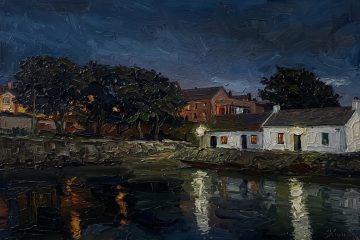
However on December 12 last, the boy woke during the night and proclaimed that he could clearly see the moon.
Not only did he perceive the existence of that respectable satellite, but he saw it as from a distance of 200 yards, and could thus accurately describe it.
“He saw hills and valleys and trees and telegraph poles, and, in fact, all the natural beauties which constitute an alluring landscape.
Moreover, he saw inhabitants of a new and extraordinary pattern. According to this veracious small boy, the Lunarians run chiefly to legs. They are constructed on the model of a cart-wheel without a rim, and revolve with enormous rapidity on the extremities of their radiating legs, which resemble in number and disposition the spokes of an ordinary and earthly wheel. These spokes, however, are evidently not developed until the Lunarian emerges from the period of infancy, inasmuch as the Lunar babies resemble pumpkins, and display no vestige of even rudimentary legs.”
Excited, learned men from the College of Sciences in California promptly undertook to investigate the small boy’s visual powers.
“In due time they reported that the boy’s lunar observations were unquestionably accurate, and they explained his vast superiority to any telescope hitherto constructed by deciding that his focal distance was of an abnormal character.
In the opinion of these ingenious and accomplished scientific persons, the boy possesses achromatic eyes constructed expressly in order to observe objects at a distance of 240,000 miles, and the inability of such eyes to perceive objects close at hand is natural and inevitable.”
Seemingly blind, had the boy been shown a cat at a distance of 240,000 miles he would have no difficulty in seeing it.
It was concluded that the discovery of this unparalleled boy represented a new era in the science of astronomy and it was suggested that his peculiarities should at once be made to serve the interests of science. He will brought to the California Observatory and mounted on a clockwork device to support his motion in tracking asteroids and comets and observing the activities of those lunar citizens.
The article concludes:
“Let us hope that this last and best gift of California to mankind will be placed at the disposal of the most eminent astronomers of the age and that they will employ every available moment in gazing through him at the wonders in the starry heavens…
He will in a few months time capture every asteroid and comet now at liberty, and become as familiar with the topography of the sun, the moon, and the planets as he is with the interior of his present observatory”
(The date of publication of this New York Times article is not noted…)
Link to Previous Monthly News
Previous monthly news stories can be viewed here Monthly News of 150 Years Ago
Help Us Find New Readers
Belfast Entries is hobby website produced entirely by a retired husband & wife featuring articles on our shared history, memories and entertaining stories of our past. The stories are free to all. If you like our posts please help us to grow our readership by sharing the posts. A growing readership would be very much appreciated.
If you enjoy Belfast Entries please consider a small donation
If you wish to To help us meet website creation/ maintenance costs please click the coffee cup below to learn how to make a small donation. Please note that every contribution is valued and that we will acknowledge your contribution below (forename only or “Anonymous” if you prefer).

Donations this month 3
Thank you Damian
Thank you Sinead
Thank you R. Meharg
We had 2 donation last month.
Copyright Notice
Belfast Entries posts & photos are our intellectual property and copyrighted to us. Where we use photos that do not belong to us, it is because we believe them to be in the public domain or shared under a Creative Commons licence with appropriate attribution. None of our content or images can be used without our consent. Note that a link to our Copyright & Takedown notice is included in the website footer on all pages.



0 Comments