William Steel Dickson – Confinement and Exile

Introduction
William Steel Dickson is not a name that immediately springs to mind when recalling the 1798 Rebellion. However, he was a man who was filled with the egalitarian ideals of that movement. The need for reform, for him, sprang from religious conviction as well as political ideology and this made him all the more inspirational, and in the eyes of his opponents, all the more dangerous.
Background
William was born on Christmas day 1744. He was the eldest son of John Dickson, a tenant farmer at Ballycraigy in the parish of Carnmoney in County Antrim, about 7 miles from Belfast. His mother was Jane Steel. In 1747, on the death of Jane’s brother William, the family added the name Steel to their own.
As a boy William was taught by the Presbyterian minister of Templepatrick, Robert White. He studied the classics, logic, mathematics, morals and natural theology. In later life Dickson recalled with affection White’s “paternal attention and valuable instructions…..In fact he taught me not only to reason, but to think”.
Education
At the age of 17 William entered the University of Glasgow. (Only members of the Anglian church were permitted to study at Ireland’s only (at the time) university, Trinity College Dublin).
His tutors in Scotland included the political economist Adam Smith and professor of civil law John Millar. He achieved so much academically and was so highly regarded that he was awarded a Doctor of Divinity.
Interest in Politics
Some also claim that Dickson’s revolutionary ideas stem from his student days.
“From this period, he became attached to political speculations; and to this cause, most of his subsequent misfortunes may be traced”
Belfast Newsletter, 31st December 1824
Presbyterians or Dissenters as they were known, were considered ‘outside the pale’ of the Protestant Ascendancy. Although they laboured under far fewer restrictions than their Catholic neighbours, Presbyterians were denied careers in the military or politics. For wealthy and enterprising businessmen, this was a considerable disadvantage.
Career and Family
On returning to Ireland, William served as minister in various parishes in counties Antrim and Down as the need arose.
A popular character, William made friends with the locals, including some of the gentry such as the Stewart family of Mount Stewart near Newtownards. So much so that in 1783 he canvassed support for Robert Stewart for the election as MP for County Down (unsuccessful) and his son, also Robert Stewart, later Lord Castlereagh in 1790 (successful).
On 6th March 1771, William Steel Dickson was ordained as Presbyterian minister of Ballyhalbert Church in County Down.
On 21st August the same year William married Isabella McMinn. (Some give the bride’s surname as Gamble). The wedding took place at nearby Glastry. The couple had a family of 6 –Jane (1775), David McMinn (1776), Mary Charlotte (1777), John Echlin (1780), Henry William (1782) and William Galaway (1785).
‘Trumpeter of Sedition’
Dickson first came to the attention of the authorities when he spoke out against what he saw as “the impolitic and unprincipled” war against the American colonists.
In two sermons ‘On the advantages of national repentance’ (13th December 1776) and ‘On the ruinous effects of civil war’ (27th February 1778), Dickson decried the severe financial effects of the war on the Irish people and the increased threat to national security.
These sermons plus two others were subsequently published and provoked a severe backlash. For speaking out against the actions of the English government he was branded seditious and a traitor.
“A general outcry was raised against me, in which those, who had never heard me preach, were very loud; and those, who had never seen me, were louder still. ‘Traitor’ ‘Rebel’ ‘Trumpeter of sedition’ were levelled at my name”
W S Dickson, A Narrative of Confinement and Exile, 1812
Membership of the Volunteers
In the late 1770’s William, like some other Presbyterian ministers such as Samuel Barber, Sinclair Kelburn and John Glendy (see post Sinclair Kelburn – The Tale of the Minister with a Musket) joined the Volunteers. This was a voluntary Protestant militia formed to defend Ireland from foreign invasion while English forces were engaged in America. They wore uniforms of home-spun Irish cloth and marched and drilled like a regular army with local landlords at their head.
On 28th March 1779 Dickson gave a sermon to the Echlinville Volunteers of County Down. This regiment had been raised by local landlord Charles Echlin and William was their chaplain and later captain. In his speech William advocated allowing Catholics to join the Volunteer movement. This controversial suggestion provoked outrage among many and Dickson was accused of being “a Papist at heart”. When his sermon was published Dickson reluctantly, on the advice of friends, agreed to moderate the language and tone he had used in the pulpit.
Relocation to Portaferry
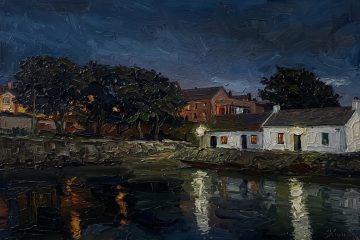
In March 1780 the Dickson’s moved to the congregation at the pretty coastal town of Portaferry on the Ards peninsula, some 29 miles from Belfast. The church was originally built in 1751 on Back Lane (now Steel Dickson Ave). As well as minister, William also taught in a local academy. His combined annual earnings were £270.


The United Irishmen
William Steel Dickson was by now well known for his egalitarian views, which were based on his strong religious and moral compass, so it is not surprising that in December 1791 he joined the Society of United Irishmen. This organisation aimed, by political means, to reform the corrupt and unjust political system in Ireland and to extend voting rights to Catholics. It is interesting to note that he ‘took the test’ (swore allegiance) in the company of his former teacher’s son, Robert White Campbell.
I,——– in the presence of God, do pledge myself to my country, that I will use all my abilities and influence in the attainment of an impartial and adequate representation of the Irish nation in parliament: and as a means of absolute and immediate necessity in accomplishing this chief good of Ireland, I shall do whatever lies in my power to forward a brotherhood of affection, an identity of interests, a communion of rights, and a union of power among Irishmen of every religious persuasion, without which every reform must be partial, not national, inadequate to the wants, delusive to the wishes, and insufficient for the freedom and happiness of this country.
United Irishmen Oath of Allegiance
The Anglo-Irish aristocracy, supported by the English government were notoriously venal, the majority of landowners seeing their Irish estates only as a means of ‘lining their coffers’
“So widespread and general was the corruption of the Irish government at this period, that it had come to unite nearly all classes, except the dominant minority, in a league for its removal”
Archibald Alison, Lives of Lord Castlereagh…. Vol 1 1861
Calls for Catholic Emancipation
On 14th July 1792, at a meeting of the Volunteers in Belfast to celebrate Bastille Day, Dickson was successful in obtaining a unanimous pledge for Wolfe Tone’s proposal in favour of total and immediate Catholic emancipation.

Not only was Dickson a firm advocate for Catholic franchise, which he believed was a right not a concession, he urged his Presbyterian brethren to forego anti-Catholic feeling as their Christian duty.
“The sermons include exhortations to a local Presbyterian audience in his meeting-house at Portaferry to abandon anti-Catholic hostility. Instead, they should acknowledge the institutionalised discrimination and sectarian false promises associated with the minority Protestant Ascendancy (of which they were not a part) which mismanaged the failed kingdom of Ireland”
W Ian P Hazlett, Religion and Politics in William Steel Dickson
Radicalisation of the United Irishmen
In 1793 the English government outlawed the United Irishmen. This forced the organisation ‘underground’ and the once constitutional body became even more radicalised. They felt that there was no hope for a just society in Ireland under English rule. As political means had been supressed the group saw their only hope for change come from military action.
The Dragooning of Ulster
The United Irishmen continued to pose a threat to the English establishment. So much so that the government passed the Insurrection Act in 1796, which basically imposed martial law on Ireland.
By 1797 a reign of suppression known as the ‘Dragooning of Ulster‘ was terrorising the Irish people. Houses were ransacked and all weapons were confiscated. Curfews were imposed and a list of inhabitants had to pinned to each door every night. The Habeas Corpus Act was suspended meaning that anyone could be arrested and detained indefinitely without charge.
“The ‘Dragooning of Ulster’ was characterised by house burning, mass deportation of suspects and murderous rampages…….”
www.encyclopedia.com
The local yeomen and Protestant Orange militias were given a ‘free hand’ to burn and destroy property, flog and brutally treat anyone suspected of ‘seditious’ opinions whether or not they had acted on them.
We can only imagine the fear and suspicion that pervaded Belfast and the countryside. Throughout Ireland, torture such as severe beatings, half-hangings and pitch-capping were deployed by these government-backed troops.
The commander in charge was Englishman Lieutenant-General Gerard Lake. An experienced soldier Lake, had fought in Germany during the Seven Years war and served during the American War of Independence. Lake vowed to “subdue the Irish” on the battlefield and off it.
“Untroubled by legal restraints or his troops violent actions, he managed to seize thousands of arms and arrest and intimidate many United Irishmen….”
James Quinn, Dictionary of Irish Biography

However, Lake’s brutality, instead of crushing the spirit of the United Irishmen movement, drove many more into its ranks.
“It did not immediately become official policy, but brutality and excesses by troops not much interested in distinguishing between the guilty and the innocent became increasingly frequent and the search for arms was conducted with ever increasing ruthlessness which, one way and another, was to determine the whole future course of events”
Robert Kee, The Most Distressful Country, 1976
The Arrest of William Steel Dickson
In the spring of 1798 Dickson was in Scotland visiting an elderly relative who was on his deathbed. On his return he discovered that the leader of the United Irishmen in County Down, Thomas Russell, had been arrested. William agreed to take his place, however, before much longer he too was behind bars, having been arrested in Ballynahinch on 5th June.
Lord Castlereagh – 2nd Marquis of Londonderry
One of the most ardent opponents of the United Irishmen movement was Robert Stewart, 2nd Marquis of Londonderry also Lord Castlereagh. Having at first supported the democratic aspirations of reform he switched sides and not only abandoned his former associates but was ruthless in having them arrested and detained.
Branded a political apostate, Castlereagh’s harsh treatment of anyone even suspected of liberal leanings made him an unpopular figure. Prodigious letter-writer, Martha McTier wrote of him on 7th March 1797 –
“Londonderry, it is said, is going to sneak into Newtown (Newtownards) after being guarded by soldiers all winter at Mount Stewart. His father seldom bolted his windows. Not a penny of rent is paid to him”
Martha McTier, 7th March 1797
Castlereagh was instrumental in the ‘show trials’ of William Orr and James Porter (see post ‘William Orr – Trial and Execution 1797‘ and ‘The Execution of Rev James Porter‘). Both of these men were executed.


True to form Castlereagh denounced his former friend and ally William Steel Dickson, claiming that as a popular figure he was “a very dangerous person to leave at liberty”
William was never, as far as we can tell, a regular at the meetings of the United Irishmen. We do not know exactly what his role would have been if he had not been imprisoned during the actual fighting itself. He certainly had no military experience on the battlefield.
Dickson himself, neither denied nor confirmed that he had been appointed as leader of the County Down forces. As one writer pointed out he would have made an excellent lawyer!
“Dickson was a man of genius, a wit and a demagogue; his writings give the impression that he would have shone at the bar…..”
Alexander Gordon, Dictionary of National Biography
The 1798 Rising
The 1798 Rising was an attempt to secure a fair political system with an Ireland governed by Irishmen and to extend the vote to all regardless of creed. It failed in the face of an experienced, well-armed and organised army led by unscrupulous commanders who decreed ‘no prisoners’.
The two decisive battles in the north of the island were at Antrim and Ballynahinch.

Subsequently the leaders of the United Irishmen were arrested and executed at the Market House on High Street (see post High Street Belfast – a History). Most had their heads impaled on spikes in Cornmarket as a warning to others.

William Steel Dickson was taken to Blaris military camp and then to the prison in Belfast (see post ‘Castle Place – The Inn, the Jailhouse and Robbs Stores‘).

The authorities went to great lengths to try to secure evidence against him.
“Besides these proceedings, in Belfast and even within the walls of my prison, my confinement was embittered, by the situation to which my family was reduced, and the knowledge that every art, and every influence, was employed, through the lower part of the county of Down, to procure the information against me, so ardently wished for.
The exertions of these were so numerous, and the zeal, with which they were prosecuted, so great, that their failure was perfectly astonishing, considering the terror of the moment, the inducements holden out, and the villainies to which they gave rise”
W S Dickson, A Narrative of Confinement and Exile, 1812
Imprisonment
On 12th August 1798 along with other political prisoners William Tennant, Robert Hunter, Robert Simms, David Bailie Warden and Thomas Ledie Birch, he was transported to the prison ship the ‘William and Mary’, anchored in Belfast Lough. Here the conditions and treatment were harsh and degrading, Dickson described it as “our floating Bastille”
The prisoners were kept in over-crowded, poorly ventilated accommodation below deck, with only brief access to the open-air. The room was only 4ft 8inches high so standing upright was impossible. There was little in the way of washing facilities so vermin spread rapidly. Every evening before the hatch was closed at 8pm “a large vessel was let down, which before morning, was grossly offensive, being filled with excrement of every kind”
On 25th March 1799 the prisoners were transferred to Fort George prison near Inverness in Scotland. Amenities in the jail were relatively better. Here Dickson and his compatriots were held for 2 years without trial.
This prison had been rebuilt in 1769 after the Jacobite Rising of 1745, when Scottish rebels had also been fighting to free themselves of English rule. While here Dickson was offered his freedom if he promised to emigrate. However, as a man who stood by his principles, William refused and demanded he be allowed to stand trial. This was denied and he remained incarcerated.
Release
On 13th January 1802, Dickson was released and he returned to Ireland. In his absence his place as minister for Portaferry had been filled by William Moreland. Moreland offered to step aside but William would not hear of it.
Dickson was now seen as a ‘political embarrassment’ by the Presbyterian church. After the failed rebellion and the Act of Union in 1801, Presbyterian opinion had veered away from any whiff of sedition.
After a year William was finally offered a post as minister of a small congregation in Keady in County Armagh. He was installed on 4th March 1803. Even now Lord Castlereagh maintained his vendetta against Dickson. He ensured that William did not receive the ‘regium donum’. This was the Crown’s contribution to a minister’s salary.
“However gifted, he was now seen by some as a liability, or at best, yesterday’s man. For, to the discomfiture of some church managers and civil authorities, ex-detainee Rev Dr Dickson – who had been neither tried, convicted nor even indicted – had declined the traditional easy option of emigration to America”
W Ian P Hazlett, Religion and Politics in William Steel Dickson, 2018
Despite his arbitrary treatment at the hands of the English government, Dickson’s views remained unchanged, perhaps even strengthened. On 9th September 1811 he attended a Catholic meeting in Armagh city. On his return to the manse, he was attacked by members of the Protestant organisation the Orange Order. William never fully recovered from his injuries.
Final Days
In 1812 Dickson was publicly denounced at the Presbyterian Synod, of which he had previously been a Moderator, for having subjected his Portaferry congregation to “Scripture politics”. In response William penned the autobiographical ‘A Narrative of Confinement and Exile’ (1812)

On 27th June 1815, Dickson had to resign from his post due to ill health. On 15th July 1819 his wife Isabella, who had long been an invalid, passed away. His children had all predeceased him or emigrated to America. Left without an income, William had to rely on the charity of friends, some of whom gave him a weekly sum to keep ‘body and soul’ together. We can only imagine how embarrassing this must have been to such a strong man. Thanks to the generosity of an Episcopalian lawyer, Joseph Wright, he had a roof over his head, a small cottage near Frederick Street.

On 27th December 1824 William Steel Dickson passed away, aged 80. He was buried in a paupers’ grave in the New Burying Ground at Clifton Street, Belfast. Most sources claim only a handful of mourners attended the interment however a contemporary account states
“His remains were accompanied to the grave by a considerable number of the most respectable inhabitants of Belfast. An impressive and eloquent address was delivered to those present, by the Rev W D H McEwen”
The grave remained unmarked until the early years of the 20th century when local historian F J Bigger had a headstone erected. Its epitaph reads ‘Ar Son Onara na hEireann – For the honour of Ireland’

Conclusion
William Steel Dickson was a man of strong beliefs and, unlike many, he was prepared to put those into action.
In his fight for reform and Catholic emancipation he lost friends, his position in life and his reputation in the Presbyterian church. He lived in a time of constant fear and saw many of those with similar beliefs executed and their bodies mutilated. Whether or not you agree with his convictions, it is impossible not to admire his spirit and his courage.
“Abstracted from the political contentions, in which he conceived it was his duty to take a part, we know not the man whose genuine philanthropy, kindness of heart, and ardent desire to promote the progress of moral and intellectual knowledge, we entertained a higher opinion”
Belfast Newsletter 31st December 1824
Related Posts
Sinclair Kelburn – The Minister with a Musket

William Orr – Trial and Execution 1797

The Execution of Rev James Porter

Castle Place – The Inn, the Jailhouse & Robb’s Store

Help Us Find New Readers
Belfast Entries is hobby website produced entirely by a retired husband & wife featuring articles on our shared history, memories and entertaining stories of our past. The stories are free to all. If you like our posts please help us to grow our readership by sharing the posts. A growing readership would be very much appreciated.
If you enjoy Belfast Entries please consider a small donation
If you wish to To help us meet website creation/ maintenance costs please click the coffee cup below to learn how to make a small donation. Please note that every contribution is valued and that we will acknowledge your contribution below (forename only or “Anonymous” if you prefer).

Donations this month 3
Thank you Damian
Thank you Sinead
Thank you R. Meharg
We had 2 donation last month.
Copyright Notice
Belfast Entries posts & photos are our intellectual property and copyrighted to us. Where we use photos that do not belong to us, it is because we believe them to be in the public domain or shared under a Creative Commons licence with appropriate attribution. None of our content or images can be used without our consent. Note that a link to our Copyright & Takedown notice is included in the website footer on all pages.



0 Comments